Showing posts with label Italy. Show all posts

Jun 22, 2026

Italy's 'third tier' cities offer local flavor without the tourist crowds


Bari women dressed in medieval costumes for the feast of St.Nicholas

Mornings in Bari Vecchia, Bari's medieval old town, belong to the fruit and vegetable vendors, butchers and bakers catering to locals doing their morning shopping or kibitzing over an espresso at a sidewalk cafe.  

It won't be long before the tour groups arrive, and a new crop of vendors begin filling tiny donuts with chocolate Nutella, and taking orders for a chilled Aperol Spritz. 

As a port city on the Adriatic Sea and the capital of Southern Italy's Puglia region, Bari plays life down the middle, sometimes catering to groups who come to tour its castle and 12th-century basilica; other times turning its attention to its working-class population of fishermen and seamen.

Old Town Bari at night

Outside the walls of the old town, in the 19th century "new city," Bari takes on a sophisticated feel with fashionable shops and pedestrian streets lined with cafes serving avocado toast topped with eggs and smoked salmon.

Bari Vecchia once had a reputation as a gritty, no-go area, but that has changed as more visitors have discovered the Puglia region, and start their travels by train, plane or car in the capital city.

Inside the walls, along narrow pedestrian streets, Bari's nonnas (grandmothers) carry on a tradition of making pasta shaped like little ears (orecchiette) on tables set up outside their homes. And when evening approaches and the tour groups leave, and local residents take back the ancient quarter for their evening passeggiata.

A Bari nonna drying pasta on the sidewalk

Cries of "over-tourism" are buzzing around Italy these days with Instagram photos of crowds blocking the way into Rome's Trevi Fountain or human traffic jams in Positano and the Cinque Terre.

The answer for those who want to avoid this scene: Look towards  Italy's "third tier" cities  such as Bari or Sulmona, a mountain town in the Abruzzo region where my husband and I stopped recently on our way to and from visiting relatives.

Spend the night at a B&B instead of a hotel, and join the neighbors for an espresso on the curb outside their house that doubles as front porch, as we did in Bari. Or enjoy breakfast on a  rooftop overlooking snow-capped mountains, as we did in Sulmona. 

Famous sites might be scarce, but serendipity awaits. You might be invited to join in a  local feast day celebration,  or be waived onto a bus by a driver even though you don't have a ticket.

The statue of St. Nicolas

We were familiar with Bari's devotion to St. Nicolas (remembered as Santa Claus for the good deeds he did for children), the former 4th century Orthodox Catholic bishop of Myra, Turkey, from a previous visit. His relics are held in a crypt below the Basilica of St. Nicolas where a special chapel has been set aside for Orthodox worshipers who look towards icons rather than statues in prayer. 

An icon of St. Nicolas on its way to a parade in Bari

On this visit, we happened to arrive at the start of a three-day festival commemorating the arrival of the saint's remains in Bari in 1018 when Italian sailors spirited his body away from Myra for fear of muslim desecration. 

Locals wait for the parade to start from Bari's 10th-century castle built by a Norman king

We were invited to join in the fun as hundreds of locals dressed in homemade medieval costumes paraded from the town center to the waterfront where the next day a statue of St. Nicolas would be put on a ship for a boat parade, followed by fireworks, a light show at the basilica and the arrival of dozens of food trucks.

Abruzzo

Moving on from Puglia, our destination was L'Aquila, Italy's Capital of Culture for 2026. L'Aquila was devastated by an earthquake in 2009 which destroyed much of the historic center and displaced thousands of people.

It's comeback story is impressive, although incomplete, with major renovations of churches and historic sites ongoing. Our plan was to spend a couple of days there exploring, but first, a detour by train to Sulmona.

Sulmona's 13th-century aqueduct

If Sulmona was in Tuscany, it might be overrun with tourists, but the town, known for its sugar-coated almond candies that appear at every Italian wedding, is hidden deep in the mountains of one of the country's least-visited regions.

The old town is a delightful mix of medieval, Renaissance, and Baroque architecture, with a blend of history and modern charm. Actor George Clooney, drew attention to Abruzzo when parts of the movie "The American" were filmed in Sulmona in 2010.

The walk from the train station to our B&B in the historical center looked doable on a map, but the route was all uphill along a busy road with no sidewalks. We flagged down a bus, and seeing our suitcases, the driver waived us on even though we had no ticket  The bus was headed to a nearby town, but he was passing through Sulmona, so he dropped us off near the main square and its 13th century aqueduct.

From there it was a short walk, uphill again, to the B&B Il Marchese Del Grillo where the energetic owner, Marta, welcomes guests into antique-filled rooms in a restored 18th-century mansion.

Our room was two flights up from the entryway. The rooftop breakfast room was another six flights higher. The reward for this was a 360-degree view of the snow-capped Apennine mountains, and a made-to-order breakfast of croissants, scrambled eggs, prosciutto, fruit and local cheeses.

Sulmona with the Apennine mountains in the background

If you have ever attended an Italian wedding, you were probably given a bag of white sugar-coated almonds, called confetti. Chances are they came from Sulmona and Confetti Mario Pelino which has been producing them since 1783, now in its 7th generation of family owners. 

Edible confetti floral arrangements 


Copper basins are used to coat the almonds with layers of sugar

A walk outside the old town to its factory is a must-do pilgrimage to buy the candies, now sold in bright colors and some coated in chocolate and crafted in the shape of flowers. There's a free museum filled with antique equipment, and a viewing platform looking down on the factory where almonds are coated with layers of sugar in rotating copper basins. 

Almost any festive occasion in Italy calls for a brass band. While sitting at an outdoor cafe, we were lucky to catch a rehearsal for the graduation of new police recruits planned for the next day.

A member of the police band takes a rest

Led by a female commander wielding a sword, the recruits, wearing blue berets and holding machine guns, marched by in formation while a band of drummers, tuba and trumpet players led the way to where the ceremony would take place.


 "It's going to be crazy," our waiter told us. All the cafe tables were already reserved for the next afternoon. But for now, we had front-row seats. We ordered another glass of wine, and sat back to soak up the scene. 


May 25, 2026

A love letter to Southern Italy: People rather than big sites reward visitors


Pasta-making at Agriturismo Regio Tratturo

Big sites and important museums are few in rural Campania, a Southern Italian region dotted with hilltop towns, known for their "cocina povera," traditional peasant food familiar to many Americans.

The reward for a long drive along a winding road past pastures dotted with wind turbines might be a stay at a farmhouse inn where the owners roll out sheets of fresh pasta on the dining room table, and tempt their guests with homemade cakes for breakfast.

Always a steep climb in the hill town of Greci

Perhaps you will visit a 15th-century hilltop village such as Greci, the town where my grandfather was born in 1901. And if it's a Sunday, you might snag reservations for a three-hour lunch at a countryside winery.

Pizza-making at CorteCorbo Winery

It might sound like a cliché to call this the "real Italy" but those words define a part of the country so far untouched by the crushing crowds in cities such as Rome and Florence.

If this sounds like your kind of travel, then take a train to the nearest small town that has a car rental agency, and spend a few days exploring between visits to more well-known areas.

Family connections draw my husband and I off-the-beaten path almost each time we visit Italy. 

Our first visits were to towns in Sicily, Calabria and Campania where Tom's grandparents were born. This spring, we made our fourth visit to Greci, the town my grandfather, Nicolas Pucci, left at age two when his parents followed uncles, cousins, brothers and sisters to Canton, Ohio to seek work in the brick factories.


A statue in Greci honoring war hero Skanderbeg 

A statue in Greci's town square honors George Skanderbeg, an  Albanian nobleman and military leader who answered a call to help the Italians defeat French-supported Insurrectionists in the 15th century. 
Seeking to escape the Ottoman invasion of Albania, the Catholic soldiers accepted an offer from the King of Naples to relocate in 51 towns scattered throughout Italy.

The communities call themselves "Arbereshe,'' and preserve an ancient Albanian-Italian dialect still taught in some schools with government grants to support cultural awareness.


This sign in Greci welcomes visitors in English and Abereshe

Our first stop is always a visit with Rita Di Minno, 79, a native of Greci who lived for a while in Australia. As an English speaker, she serves as the unofficial ambassador to American visitors, welcoming many into her home to look at books and pictures about the history of Greci.


Rita outside her home in Greci

The  population is declining (down to 400 from around 700 two years ago), as it is in small towns all over Italy. A bed and breakfast and small restaurant closed recently, leaving just the pharmacy, two churches, an ATM and a bar that serves pizza on Saturdays and Sundays.

Many of the houses are owned by Italians from other parts of Italy, Ukrainian refugees and a few Americans ex-pats who have come to explore their roots. While walking around, we met John Pastor from Akron, Ohio, whose  great-grandparents were born here. He and his wife live part-time in the two-story, two-bathroom home they bought for $55,000. 

John Pastor from Akron, Ohio 

It was John's mother's first cousin, John Mazzarella of Florida, who founded an organization called Greci Cousins. With John's help, my family and others traced our ancestry to one of 15 original Albanian families who settled here. Although we know of no direct relatives, everyone is considered a "cousin" because people in the town mostly married each other.

"There are many people with the name Pucci here," John told me. "You are in good company."

A close friend from your home town, who is not a direct relative, is called a paisan -  a fellow countryman or compatriot.

At home near Greci with Maria and Dante

Two of our favorite paisans are Maria Castielli and her husband, Dante Molinario who live 30 minutes from Greci in nearby Ariano Irpino. Maria's mother was born in Greci, but Maria was raised in England so speaks fluent English as does Dante who worked for a while in Toronto.

They generously welcome us into their home for dinner when we visit. In the past, they shared homemade prosciutto from a pig they killed themselves and wild asparagus from their garden. This time, Maria prepared an antipasta called “Cheat Pizza,” pizza dough on the bottom filled with tomato sauce and cheese and topped with a flaky pastry. Dante made us a special pasta with their homemade tomato sauce and pork sausage. They don't kill pigs anymore, but they preserve their own peppers, olives, asparagus, tomato sauce, all stored in huge basement pantry.

Dante serves the pasta 


Maria with her Cheat Pizza

Our home base for a three-day stay in the area was Agriturismo Regio Tratturo, a farmhouse inn reached along a narrow, winding road, once a path used by shepherds to move herds and flocks from one pasture to another. Today the hillside are dotted with wind turbines and olive groves. 

The view from Agriturismo Regio Tratturo

The delightful owner, Antonietta, takes care of four rooms and a restaurant where everything on the menu is homemade from ingredients grown or raised by she and her husband, Rinaldo and their staff. They host large groups for weddings and birthdays. When we checked in, they were busy making fresh pasta on the dining table for 50 guests coming the next day.

Antonietta her ciambella

"Sweet or savory," Antonietta would ask us about what type of breakfast we would prefer. If we said savory, then an omelette would appear along with fresh bread, jam, homemade peach juice and little biscotti cookies. 

A choice of "sweet" one morning produced slices of a ciambella, a Campanian-style breakfast bundt cake flavored with Strega, a sweet, yellow herbal liqueur made in nearby Benevento.

Irpina in the province of Avelino is this area's wine region. Although not as big or well-known as Tuscany, its mountains and volcanic soils help a scattering of family-owned wineries produce three out of four of Campania's DOCG (Controlled and Guaranteed Designation of Origin) wines. 

Looking for something to do on Sunday when almost everything is closed, we found CorteCorbo Winery in the town of Castelfranci, 35 miles from Ariano.

On Sundays, the winemaker, Antonia Romano and her son, Antonio, host a three-hour lunch and tour at the house that belonged to her grandfather. 

After a GPS mix-up that took us down a one-lane road to a bridge that was closed, we recovered, and after an hour and half's worth of driving, arrived at noon to find the outside terrace filled with guests, including a group of Americans stationed at a naval base in Naples. 

In between pours of their six wines made from three varieties of local grapes, we snacked on an antipasti spread of roasted pumpkin, cheeses, eggplant parmesan  and salami while Antonia taught everyone how to stretch dough and make pizzas.


Antipasti on the terrace


Antonia supervises the  pizza-making


Tom readies a pizza for the wood-fired oven

It was around 2 p.m. when we finally gathered in the dining room for a sit-down dinner. Antonio played and sang "Country Roads" on his guitar while we toasted our hosts, and stayed until 4 p.m  enjoying pasta, meatballs and tiramisu. 


New friends and a view of Castelfranci from CorteCorbo winery

Is it a cliché to call this the "real Italy," especially with so many English-speaking Americans around? Perhaps, but I prefer to remember it as special Sunday in the Italian countryside with generous hosts and new friends. It doesn't get much more real than that.  

Aug 15, 2025

Alaska Airlines vs. Delta: Game on


Alaska Airlines purchased Hawaiian Airlines in September

Seattle-based Alaska Airlines is hoping its loyal base of Northwest customers will no longer have to look to competing airlines when booking international travel.

"This is our city to serve," said CCO Andrew Harrison, laying down the gauntlet primarily to Delta Airlines which flies 25 percent of international passengers out of Seattle-Tacoma International Airport compared to Alaska's 16 percent.

Alaska, which flies 57 percent of Seattle's domestic passengers, uses partner airlines for international connections. Now with a fleet of wide-body Boeing 787 Dreamliners acquired through its purchase of Hawaiian Airlines last September, it has been one-upping the much-larger Delta with a series of announcements aimed at including flights to 12 international cities by 2030. 

 Alaska will be flying non-stop between Seattle and London Heathrow; Rome; and Reykjavik, Iceland (seasonal flights aboard the 737-8 MAX) starting in the spring of 2026. It began non-stops to Tokyo-Narita in May, and will add non-stops for Seoul (using the Airbus A330-200) in September. 

Delta, which flies non-stop to Seoul, Tokyo, Taipei, Shanghai, London, Amsterdam and Paris from Seattle, relies on partners KLM and Air France for onward connections in Europe. It answered Alaska's moves by announcing plans of its own for a new non-stops to Rome and Barcelona next May, cutting out the need to connect through Paris or Amsterdam.

What will all of this mean for passengers? Hopefully some price competition. Alaska will now be competing with its current partner, Iceland Air, on flights to Reykjavik;  British Air on flights to London; and Japan Airlines on flights to Tokyo. 

Delta customers, unhappy with its requirements for elite status, could decide to switch their elite status to Alaska, given a wider selection of international options that can be booked directly with the airline. Delta requires a minimum yearly spend of $5,000 to maintain Silver Elite status while Alaska's requirements for MVP Gold center on the number of miles or segments flown, bars easier to reach with the addition of longer, international routes.


Flight amenities and comfort will depend on the specific route. Delta has the superior in-flight seat-back entertainment system while Alaska passengers must stream movies and TV shows on their own devices. Delta seems to have lowered the quality of its food service on international flights in recent years, so it will be interesting to see if Alaska can do better.


Alaska‘s newest lounge at Sea-Tac Airport

Both airlines have high-end lounges in Seattle-Tacoma International Airport, a busy airport getting busier with the number of new international routes being added by Alaska, Delta another airlines. 

To play in the big leagues, Alaska will have to up its game when it comes to the level of customer service and staffing that international flights require. Sea-Tac customers often complain of long waits to reach someone on the phone or long lines at its airport service desks when problems occur. 

Had a data center hardware failure that caused a three-hour, system-wide ground stop here recently occurred on a flight originating in Europe, customers would have been entitled to major cash compensation under European laws.

EC Regulation 261 grants passengers the right to seek compensation when they have experienced delays (two to four hours or more), cancelled, or overbooked flights, with few exceptions. Those include weather, strikes, security risks etc. but not technical problems.

All carriers, including U.S.-based airlines, are subject to the rules when flying inside or out of the EU. 


Oct 30, 2023

Italian days: Wild boars, sheep in the road, tasty meatballs and old friends


Maria, Dante with their homemade meatballs and peas

"Be careful," warned my friend Maria. "There are wild boars roaming around."

My husband,Tom, and I have made many memories traveling around Southern Italy's rural Campania region.  

Perhaps this time, we'd make another. 

As it turned out, we encountered no boars, but we did run into a flock of sheep blocking both sides of a two-lane road leading to Greci, a hill town between Bari and Naples, where my grandfather was born.

Sheep in the road on the way to Greci

Maria and her husband, Dante, live in nearby Ariano Irpino. We met 13 years ago on our first visit to Greci. Maria's mother was born there, and Maria, who lived for a while in England, speaks fluent English.

After touring Greci, we enjoyed a memorable meal at their home, including prosciutto from the recently-slaughtered family pig. We met again a few years ago, this time while we were exploring more of Southern Italy with my husband's brother, Al, and his wife, Nancy.

Al mopped up Maria's sauce with his bread, a gesture for which Dante bestowed on him the title of "Buona Forchetta," or Beautiful Fork, roughly translated "Good Eater."

It's been our good fortune to have stayed in touch with Maria and Dante and others in Italy whom we've met over the years during family visits (Tom's family is from Southern Italy and Sicily) and through story assignments for the Seattle Times and other publications. 

When the Covid pandemic ended and we had a chance to travel again, I stole an idea from another journalist whom I admire: Pick destinations where you know people, and make plans to reconnect.

On this trip, a return to our favorite big city in Italy - Naples - and a desire to see something new - Lecce, a Baroque jewel box in southern Puglia - were the jumping off points for visits with several sets of old friends. A bonus was detouring through or staying in towns tourists rarely find a reason to visit. 

Navigating our way around the sheep in a rental car was nerve-wracking, but worth it considering the reason we were on this back road was because we had detoured through the tiny town of San Marco dei Cavoti, the center of torrone production (nougat candy) in Southern Italy. We stopped at a century-old shop for vintage boxes of torrone baci (chocolate nougat), then found a bakery with a few tables on a shady patio. The warm weather called for sampling our new favorite coffee drink - crema di caffe -  an icy, whipped concoction of espresso, cream and sugar eaten with a spoon. 

Crema di Caffe in San Marco


Waiting for us in Greci was Rita DiMinno, the town's unofficial ambassador to American visitors, many of whom are members of an online group called Greci Cousins. Rita was born in Greci but moved to Australia with her family as a young girl after her father, a shoemaker, found work there. Rita learned English, and returned to Greci for a visit. There she met, and later married her late husband, Pino Perillo.

Rita in her kitchen with her homemade tiramisu served with a shot of Strega, an herbal liquer from the nearby town of Benevento.

  
Greci's history is unique because it is one of 51 Italian towns settled by Albanians between the 15th and 18th centuries. The communities call themselves "Arbereshe,'' and the people in these towns speak an Albanian dialect as well as Italian. 

Albanian soldiers settled in Greci sometime in the mid-1400s when the King of Naples invited them to relocate after the military leader, Skanderbeg, answered a call to help the Italians defeat French-supported insurrections. 


A new monument in Greci honors the Albanian war hero Skanderbeg

Nearly 4000 people lived in Greci in the 1950s. Now there are only about 450, most of them retired. But things are looking up as more people from Naples make their summer homes here. After a slice of her homemade tiramisu, Rita took us on a walk around town to show us what was new including a new monument dedicated to Skanderbeg, a new restaurant (the only one in town) and several bed and breakfasts in addition to a caffe/bar and a doctor who makes house calls.


The new restaurant in Greci is called Ha e Pi,  Arbëresh for Eat and Drink.  


Rita, Tom and me in front of her home in Greci


Together again with Dante and Maria


After our walk with Rita, we had dinner once again with Maria and Dante in Ariano. They fixed a pasta with homemade tomato sauce and a traditional dish of homegrown peas and meatballs, followed by fresh figs from their tree. They didn't kill a pig this year, so no prosciutto. Maybe next year, they said, if they can get some help. I see a return visit in our future.

Sant'Agata dei Goti

Sant' Agata dei Goti

Our next stop was Sant' Agata dei Goti, an ancient town built on a rock cliff above a river in an area called the Sannio, off-the-radar compared to Tuscany in the north, but an abundant agricultural area known for its wine.

Sant' Agata historical center


In 2008, while searching for a place to stay, we found Sentieri Luminosi, a recently opened bed and breakfast. Our hosts were Loredana Fusaro, then a cook at a local restaurant and massage therapist, and her husband, Enrico Pofi, a photographer. They moved here from Naples, and bought a 19th-century stone building on a bluff overlooking the town. We were their first non-Italian guests, and since they both spoke some English, we got to know each other. I wrote a story about the Sannio which included a mention of Sentieri Luminosi, and a picture of Loredana and Enrico in their yard surrounded by fig trees.

Fast forward to 2023. Enrico and I connected on Facebook. Yes, they remembered us, and would be happy to meet. We set a time and date for a rendezvous in town for a drink, then they generously invited us back to their home for lunch. A few minutes in the kitchen, and Loredana had assembled a meal of pasta, local cheeses, salami, olives, cooked greens, bread and wine.  

Lunch with Enrico and Loredana 


We talked and ate at the same table where we had breakfast 15 years ago. Loredana went into her file drawer and pulled out a copy of the story I had written which she had saved all these years. It was one of those moments that we all hope for when we travel, a time when we no longer feel like tourists, but friends.

The Arch of Trajan

Benevento

Our base for exploring Campania was Benevento, a mid-sized city about 30 miles northeast of Naples. Reminders that it once flourished as a Roman colony include a restored Roman theater, an archeological  park and an arch at the entrance of the town, built in 114, considered to be among the best-preserved Roman structures in Campania.

Shop selling all things Strega

Benevento became famous for two things: witches and Strega, a powerful greenish-yellow herbal liqueur, served and sold everywhere as a drink and in chocolate candies and torrone. Thirteenth-century folklore spread the belief that Benevento would be a gathering place for Italian witches. Many famous writers, musicians and artists wove tales of witches into their works, taking inspiration from the Benevento legend. 

Strega takes its name from the legend of the streghe (Italian for witches). its label depicts the streghe dancing under a walnut tree.

Strega includes 70 herbal ingredients include saffron

Benevento's main street is pedestrianized with side streets leading to hidden restaurants and cafes. There's a Sunday flea market and a lively early-evening passegiatta when friends and families meet for a stroll, a drink or last-minute shopping before the stores close.  Some years ago, while staying at a B&B in Tbilisi, Georgia, we met Gianna Fusco, an Italian professor whose home town was Benevento.

We stayed in touch, and met up a few years ago in Naples where Gianna was teaching. When she saw on Facebook that we were again in Italy, she got in touch. Although she now lives in L'Aquila where she teaches American literature and American studies, she drove to Benevento to meet us. We owe her mother a big thank you for a bottle of the homemade limoncello she sent our way, and Giana an invitation to come visit in Seattle.

Tom, Gianna and I in Benevento. The obelisk in the background was originally erected for the Roman Temple of Isis. Heroglyphs appear on four sides 


Last stop: Rome

Rome has been so inundated with tourists, we had decided not to stop, and instead take a train directly from Benevento to the airport to catch a flight to Reykjavik, Iceland. We changed our mind when we found out our old friend, Letizia Mattiacci, had relocated there after selling her bed and breakfast inn in Assisi. 

Letizia and us in Rome

It was 20 years ago, that we found Agriturismo Alla Madonna del Piatto five miles off the main highway above Assisi in the central Italy.

Letizia and her Dutch husband, Ruurd de Jong, gave up careers as entomologists to buy and renovate the abandoned farmhouse built centuries ago as a refuge for shepherds.

With six cozy rooms, breakfast and dinner, Alla Madonna made an ideal base for visiting the medieval villages of Umbria, and since Letizia offered cooking classes, we were able to take advantage of a rainy afternoon to trade in a few hours of sightseeing for the chance to tinker in an Italian kitchen.

It was a memorable experience that made its way into a story for The Times. Letizia, like Loredana in Sant' Agata, had saved a copy of the print version that included a picture of her. 

After two years of dealing with a difficult family situation, Letizia, the author of two cookbooks, has reinvented herself in Rome. We met for a drink in her new neighborhood, Appio Latino, a short Metro ride from the historical center. She has launched a new business - Madonna del Piatto - and restarted cooking classes. Instead of a farmhouse,  students will find themselves in an authentic Roman neighborhood devoid of tourists. There they will spend several rewarding hours cooking in Letizia's kitchen, then sharing a four-course lunch in her dining room.


Hosteria L'Orso 80

Our visit with Letizia was worth detouring to Rome for one night, but I wasn't sorry we weren't staying on. The crowds were getting on my nerves as we walked in a human traffic jam past the Trevi Fountain to a restaurant near the Piazza Navona that's always been a favorite. 

I reluctantly made reservations, expecting it to be flooded with tourists and service to be rushed. But as we got closer, the crowds seemed to disappear, and there, on a quiet street, was Hosteria L'Orso 80, mostly as we remembered it. 

The warm weather meant we could sit on the patio. We ordered what we always order  - the antipasti della casa -- more than a dozen bowls  filled with roasted eggplant, zucchini, peppers, prosciutto, salami, cheeses, salads, melon and meatballs.

The price has gone up a bit since we first visited years ago, but not much else has changed. A man still sits at a vintage cashier's desk inside tallying up the bills. Sometimes the waiter will throw in an extra meatball.

After a week spent reconnecting with Italian friends, D'Orso felt like an old friend too. 


Oct 23, 2023

Bella Napoli: Our favorite Italian city


Asked to name a favorite Italian city, few would pick noisy, crowded traffic-choked Naples, Italy's third largest city just south of Rome.  

Yet here we are, sipping a spritz and lemon granita at a sidewalk table as motorcycles whiz by, and happy music blasts from inside a cafe on the edge of the Spanish Quarter.

Rome has its antiquities. Florence has its art. Naples' draw has always been its setting, with Vesuvius, still an active volcano, looming behind a sparkling bay and busy working waterfront. Most visitors head for the National Archaeological Museum to see its collection of artifacts from Pompeii and Herculaneum, towns buried by the volcano's eruption in 79 A.D., then use the harbor as jumping-off point for trips to the islands of Capri and Ischia.

Now more travelers are discovering the city itself as it welcomes tourists with crowded but safe, well-lighted streets, open-air restaurants, walking tours and Airbnbs. Its reputation for scooter-riding bag snatchers lives mostly in the past, helped by television personalities such as Stanley Tucci who featured its fried pizza in the first installment of his popular CNN travel show "Searching for Italy." 


Crowds on Via Toledo waiting for fried pizza

Street food is best eaten on the street 

We make it a point to spend a few days in Naples whenever we're in Southern Italy. On this trip, Naples was the jumping off point for a trip to Lecce, a lovely Baroque town in Apulia five hours south by train in the heel of Italy's boot.

Ruled first by the Greeks, then Romans, Normans, Spanish and French, Naples is divided into 21 zones, each with a collection of monuments, palaces and Gothic and Baroque-style churches whose plain facades hide interiors filled with frescoes, paintings and elaborate marblework.

Having seen all the major sites on past trips, we settled in here in the Spanish Quarter, a warren hilly, narrow streets and slim houses, built in the 16th century to house Spanish occupying troops. Just a few steps west of the chic shops on Via Toledo, the "Quartieri Spagnoli " is a traditionally poor area that's rapidly gentrifying. The modest Il Convento hotel where we stayed in past years now quotes rates of $200 and up. The Hosteria Toledo, a corner  restaurant that was once a favorite, gets bad reviews. American-style eggs and pancakes are on the menu at Birdy's Bakery, a breakfast spot in the nearby Chiaia neighborhood. 

Our neighborhood market: Part vegetable stand, part religious shrine

But authenticity is there to discover. Our Airbnb on the fifth floor (no lift) of a stone building required four keys to enter. Laundry flaps from our neighbors' balconies. Wandering through the Pignasecca street market, we found traditional Neopolitan pastries such as fiocchi di neve, little brioche snowballs filled with cream. The best cafes are in a funicular ride away in Vomero, a quiet, upper-class neighborhood high above fray, appreciated by locals for its cooler temperatures and parks. The best pizzas cost no more than 10 euros, and nowadays, go way beyond the traditional Margherita (Buffalo mozzarella, tomato sauce, olive oil and basil) to vegan and gluten-free offerings with toppings such as ricotta cheese and zucchini flowers.

Fiocchi di neve


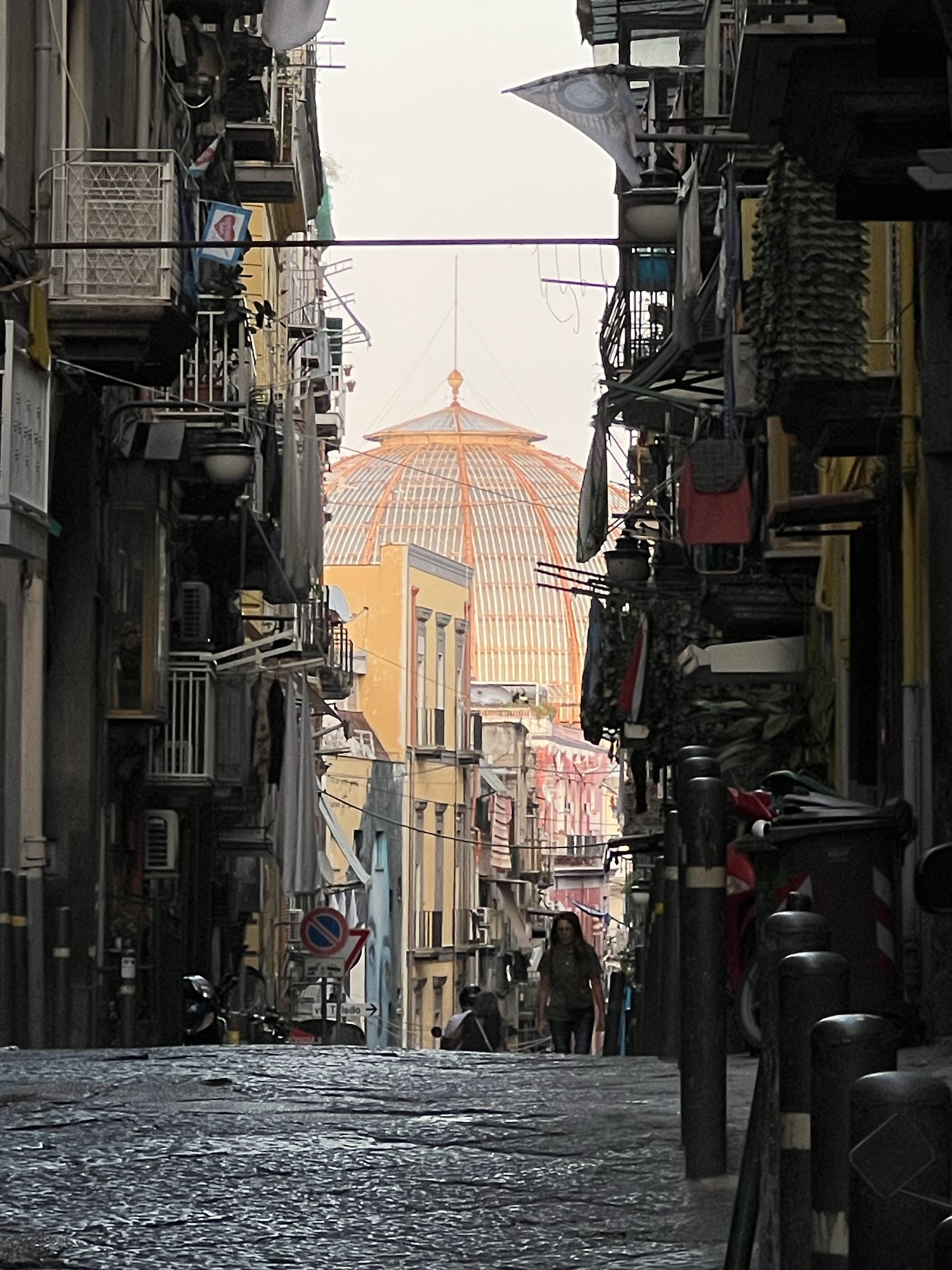
A street in the Spanish Quarter looking towards the Galleria Umberto, an 1887 indoor shopping mall with an arched glass and iron dome.
,

 Castellammare cable car 

An easy day trip out of Naples is a train ride along the Sorrentine coast to Sorrento. Most people use the Circumvesuviana line from Naples Centrale station to go to Pompeii, but if you've seen Pompeii, then consider visiting some of the other towns just past the ruins You'll have the train to yourself since almost everyone gets off at Pompeii. Two of our favorites were Castellammare di Stabia and Sant'Agnello.

Castellammare was built over the ruins of the ancient Stabiae: like Pompeii, a village totally destroyed in 79 AC by the eruption of Vesuvio.The cable car takes about eight minutes to reach the top of Mt. Faito, 4,500 feet above sea level, opening up sweeping views of the town, the Gulf of Naples and Vesuvius. Locals enjoy the park for picnics and walks in the cool mountain air during the summer.


The walk from Sant' Agnello with Vesuvius in the background

Sant' Agnello is the last town before Sorrento heading east on the Circumvesuviana. If you're up for a scenic walk, exit the train here and follow a path along the coastal road all the way to Sorrento. The walk is a little over a mile and takes about 30 minutes. Along the way, you'll pass luxury hotels perched on the cliffs overlooking the sea and fancy beach clubs below.

La Marinella Beach Club 


Sorrento: Gateway to the Amalfi Coast

By now you'll probably have had your fill of crowded trains, so take a high-speed ferry back to Naples from Sorrento's Marina Piccola port. You can walk to the port from Piazza Tasso by descending about 100 steps, or take a bus. The ferry ride takes about 45 minutes, time enough to have an Aperol Spritz onboard while you pass by Vesuvius, and consider what life is like for the three million people who live close enough to be affected by another eruption.