Showing posts with label Spain. Show all posts

Sep 30, 2025

Passengers should benefit from Sea-Tac's new international competition


Cathay Pacific's announcement that it will restore non-stop flights between Seattle and Hong Kong next year is icing on the cake for Seattle-Tacoma International Airport where airlines added six new international services this year, and have plans for at least another six in 2026.

Cathay Pacific ended its Seattle-Hong Kong service during the Covid pandemic. When it resumes on March 30, 2026, it will fly five times per week on the 250-seat Airbus A350-900, offering another new gateway to mainland China, Southeast Asia and India.

This comes on top of new non-stops to Seoul and Tokyo added by Alaska Airlines this year as well as a new Edelweiss Air flight to Zurich and an SAS flight to Copenhagen.  Delta will add new non-stops to Barcelona and Rome next year while Alaska will also add a non-stop to Rome as well as Reykjavik and London

Seattle now has service to 36 international destinations on 30 different airlines, a major advantage given the 750,000 visitors expected for next year's FIFA Men's World Cup. Seattle will host six matches June 11-July 18th, also the height of the Alaska cruise season

Anyone who has traveled through the airport recently has experienced the long back-ups at arrivals and departures, long lines for rental car buses and long waits for loved-ones in a cramped international arrivals area.

One might wonder, "Is Sea-Tac up to the job of accommodating all the extra flights and passengers?''

And how about the airlines? Delta and Alaska are the airport's primary carriers. Delta has loads of experience with international flights, but Alaska is just getting started with international expansion plans that have been taking shape since it acquired new long-haul aircraft in its merger with Hawaiian Airlines.

Let's look at the airport first, then talk about how passengers might be affected by the growing competition.

Sea-Tac is undergoing major renovations to improve its baggage claim area and screening equipment; roadways leading into the airport; and amenities in its C concourse. The goal is to complete most of the work by the time FIFA fans arrive. 

With limited ability to expand outward, Sea-Tac is building up, adding three new stories atop the existing C concourse

A rendering of new Concourse C

The  main floor will include a shopping area called Marketplace at C.  Dining and retail will frame a tiered, open amphitheater with a stage for live music. The upper level will house new restaurants, and provide views of the airfield and Olympic Mountains via a lookout deck.

The road improvements, with dedicated lanes for rental car buses, should alleviate the long waits for buses that now get stuck in general airport traffic.

Working with the Transportation Security Administration, the Port of Seattle is optimizing the outbound baggage handling system (BHS). A new system will replace the current aging conveyor system, and position the airport for future growth.

With the number of additional international passengers due to arrive this year and next, Sea-Tac would do well to tweak recent changes at the international arrivals waiting area, called the Gina Marie Lindsey Arrivals Hall on the baggage claim level.

Baggage claim level TSA checkpoint

A recently-opened new security checkpoint on that level (the others are upstairs on the ticketing level) is convenient for passengers being dropped off with only carry-ons, but has added to the general congestion in an already packed waiting area furnished with uncomfortable cube furniture resembling concrete blocks and lacking phone chargers. 

International arrivals waiting area

The wait times are long for arriving international travelers due to an experimental system (to be revisited during a one-month trial starting this month) that requires them to pick up their checked bags before going through Customs and Immigration. Those waiting to meet their loved-ones deserve a more comfortable seating area. 

When it comes to flights, passengers can look forward to more competition which should translate into more competitve fares. Delta and Alaska will be going head-to-head on the new Rome flight as well as flights to Tokyo, London and Seoul.

Both airlines are adding to and improving their lounges at Sea-Tac. Delta customers, unhappy with its requirements for elite status, could decide to switch their elite status to Alaska, given a wider selection of international options that can be booked directly with the airline. 

Delta requires a minimum yearly spend of $5,000 to maintain Silver Elite status while Alaska's requirements for MVP Gold center on the number of miles or segments flown, bars easier to reach with the addition of longer, international routes.

Flight amenities and comfort will depend on the specific route. Delta has the superior in-flight seat-back entertainment system while Alaska passengers must stream movies and TV shows on their own devices. Delta seems to have lowered the quality of its food service on international flights in recent years, so it will be interesting to see if Alaska can do better.

To play in the big leagues, Alaska will have to up its game when it comes to the level of customer service and staffing that international flights require. 


Sea-Tac customers often complain of long waits to reach someone on the phone or long lines at its airport service desks when problems occur. 

Alaska's integration with Hawaiian is progressing in stages, causing confusion and frustration among passengers who go to agents at each airline expecting help, only to be referred to the other.

Beat of Hawaii Travel News lays out the problems in a lengthy post.

"Until the airlines are fully integrated, passengers may need to double-check everything from mileage earning, upgrade eligibility, and seat selection rules. This requires extra work at booking and again before departure, especially for those booking through Hawaiian’s platform but ending up on Alaska metal," it advises.


May 1, 2025

Fes: Morocco's oldest city where tourism takes second place to daily life


Parking a donkey in the Fes medina

The last time we were in Morocco was 15 years ago on a short hop from Madrid to Marrakech. It‘s a beautiful city filled with history, but we were hassled to the point that I didn‘t think we would ever return.

The souks overflowed with cheap reproductions of traditional Moroccan handicrafts, some made in China and almost all priced in euros for the convenience of French and Italian sunseekers. Haggling is a way of life as it is in many parts of the world. Sadly, it wasn;t always good-natured.

“You are Jewish, I can tell,” one shopkeeper called out to my husband, Tom, when we left his jewelry shop without buying (Tom is Italian-American). Another accused us of being from Texas.

The Fes medina

Yet, here we are again, this time deep inside what some consider the best-preserved old city in the Arab world, the sprawling, labyrinthine medina of Fes el BaliOn a walk with our friend Jamal, a freelance guide whom we met on Airbnb, we encounter a donkey and its owner along one of the 9,000 “streets” - maze-like alleys really - in the 13th century walled  old city. 

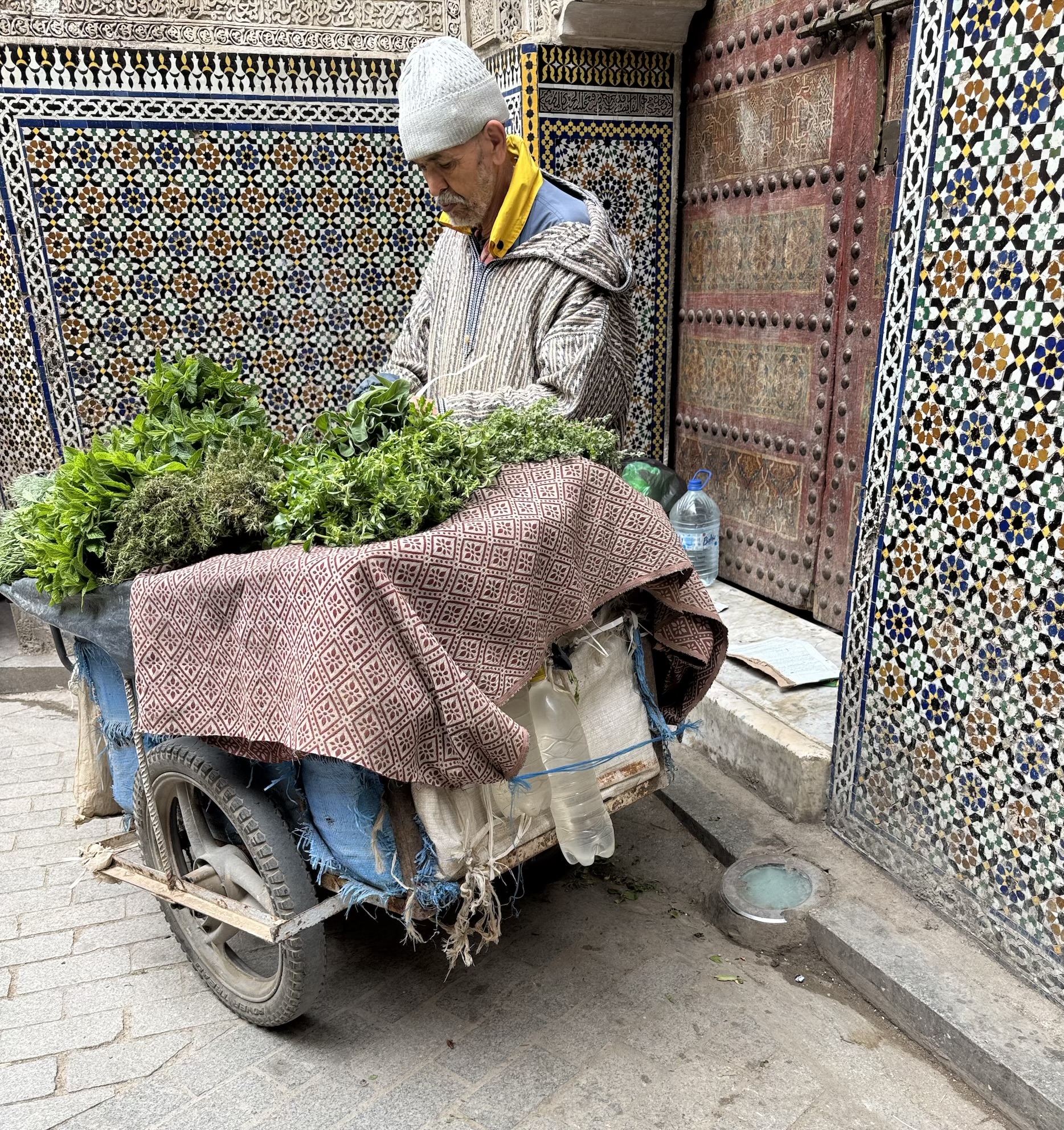
Vendors use push carts to deliver fresh mint to tea shops 

With traffic limited to animals, pedestrians and push carts, we walk with Jamal through lanes once measured by the width of camels to souks filled with vendors working in closet-like niches. They stir vats of soup, brew tea, bake bread and shatter slabs of peanut nougat into bite-sized pieces. One section is devoted to wedding dresses. Others to metal crafts, weaving and woodcarving. Stalls overflow with tiny bottles of orange blossom oil, shiny tea pots and brightly-colored leather cushions. Bargaining is expected, but no one pressures us to buy. 

Tanning and dying leather is one of the major industries in Fes


Tea shop in the medina

Walking through an unmarked opening in a wall, and up several steep flights of narrow stairs, we meet Abdullah, 71, and drink our first of many glasses of tea brewed with piles of fresh herbs delivered daily to the stand he has operated in the Medina for 50 years. We sit in stools while he boils the water in copper cups on a tiny stove, then pours it into tall glasses stuffed with mint, lemon verbena and orange blossoms.


Abdullah has been brewing tea in the medina for 50 years


Boiling hot water for fresh mint tea


Sorting through fresh mint and other herbs delivered daily

Lesson learned:  Morocco's imperial cities of Marrakech, Fes, Meknes and Rabat- the homes of sultans and kings over the centuries - are as different from each other as Seattle, New York, Houston or Los Angeles.

Marrakech, the most well-known, is a logical first choice for most visitors, but on our second visit, we were determined to delve deeper. Several days spent in Fes, Morocco's oldest city and considered the Islamic country's spiritual capital, and then Rabat, the current capital, left us feeling immersed in an exotic culture more focused on daily life than tourism.

One of our best decisions was to forgo stays in modern hotels in the newer parts of each town in favor of staying in riads tucked inside the walled medinas. Riads are traditionally-styled multi-level guest houses with rooms facing an inner courtyard. They were formerly the homes of wealthy families and  merchants until they moved to the new towns (Villes Nouvelles) built by the French. After that time, many of the  riads became rooming houses for poor residents who lived in the medina. As tourism advanced in Morocco, many were turned into hotels, offering a peaceful retreat from the chaos outside.

Deliveries are made by pushcarts or donkeys in the Fes medina

In Fes, the five-story Riad Layla became our home for the next five nights. A taxi dropped us at the nearest “gate,” or portal to the medina. Men with pushcarts wait to help people with their luggage, but since we had only roller bags, and Riad Layla wasn’t far, we walked in on our own and rang the buzzer next to a heavy wooden door. 


Riad Layla's inner courtyard


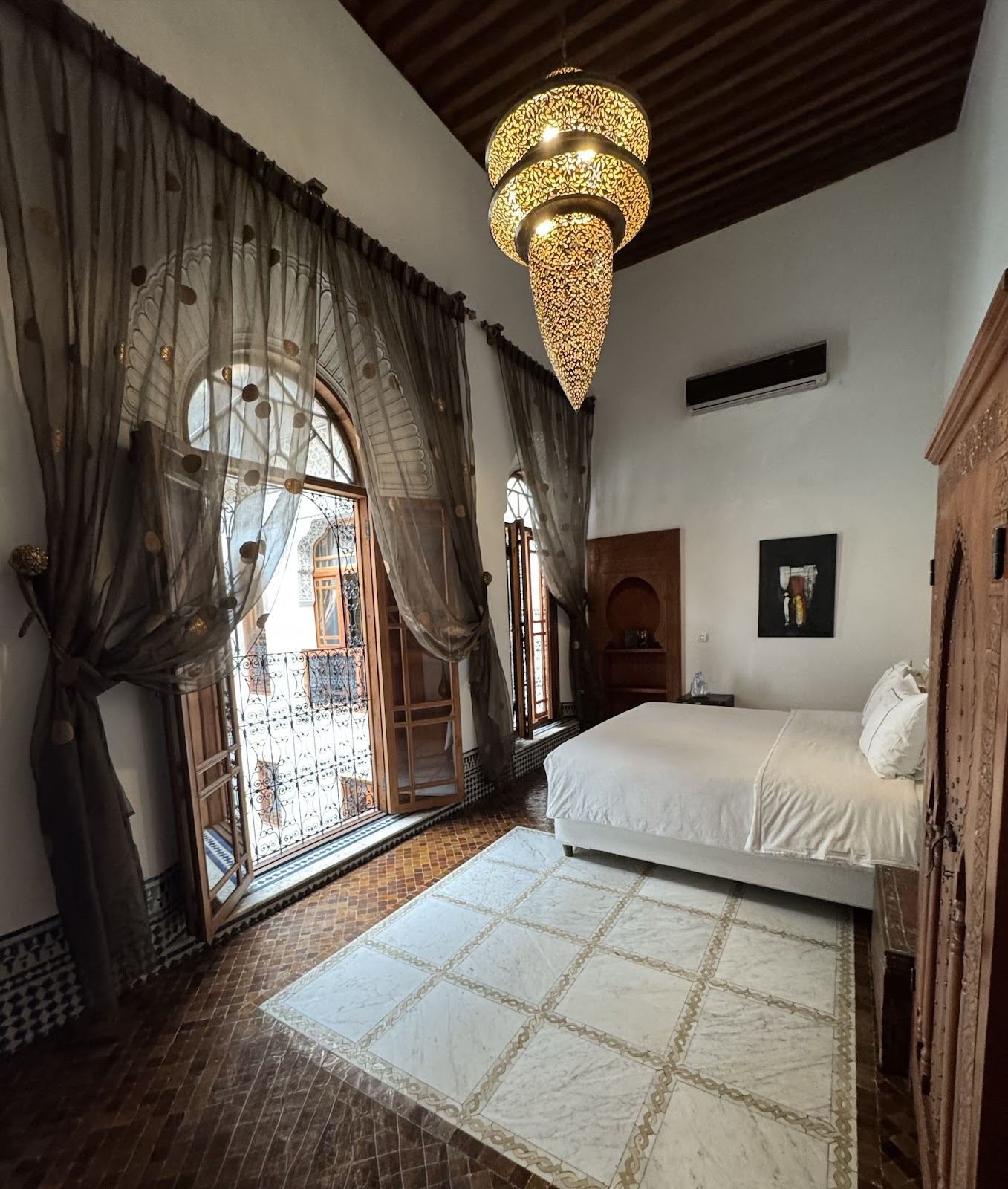
Our bedroom


Windows open to the courtyard rather than the outside


Overlooking the courtyard garden was our third-floor room, reached by climbing 30 narrow, winding steps with no handrails. Getting to breakfast each morning required going down those steps again, crossing the courtyard, and climbing another 72 steps to the fifth floor rooftop terrace. There a traditional Moroccan breakfast awaited - fresh-squeezed orange juice, coffee, tea, eggs, and assortment of savory pancakes, corn cakes and some French touches (Morocco was a French protectorate from 1912-1956) such as fresh baguette and warm croissants. Like most everything in Morocco, our riad was a bargain at around $125 per night including breakfast. 

Touring the medina with Jamal

Our second-best decision was to ignore advice to not try to navigate the Medina on our own without joining either a group tour or hiring a private guide for the entire time. Using our introductory two-hour walk with Jamal to orient ourselves, we then relied on a GPS to map and track where we were going and where we had been.  Landmarks helped (turn left at the stall where the guy cuts chicken with a scissors) and hints from Jamal such recognizing the shape of street signs indicating a dead-end.

Scattered throughout the medina are mosques, museums, the world's first and still-operating university, and a massive leather tannery where visitors are given bouquets of mint to hold to their noses to mask the smell.

Making chicken sandwiches in the Fes medina 

Street food vendors, woodworkers, metal craftsmen and bakers carry on family-owned businesses that go back generations. Moroccans generally shy away from having their pictures taken, so to create some opportunities to photograph and gain a better insight into culinary traditions, we spent several hours on a street food tour one morning with Mostafa Laachaci, a guide for a local travel agency whom we found on the website Get Your Guide.

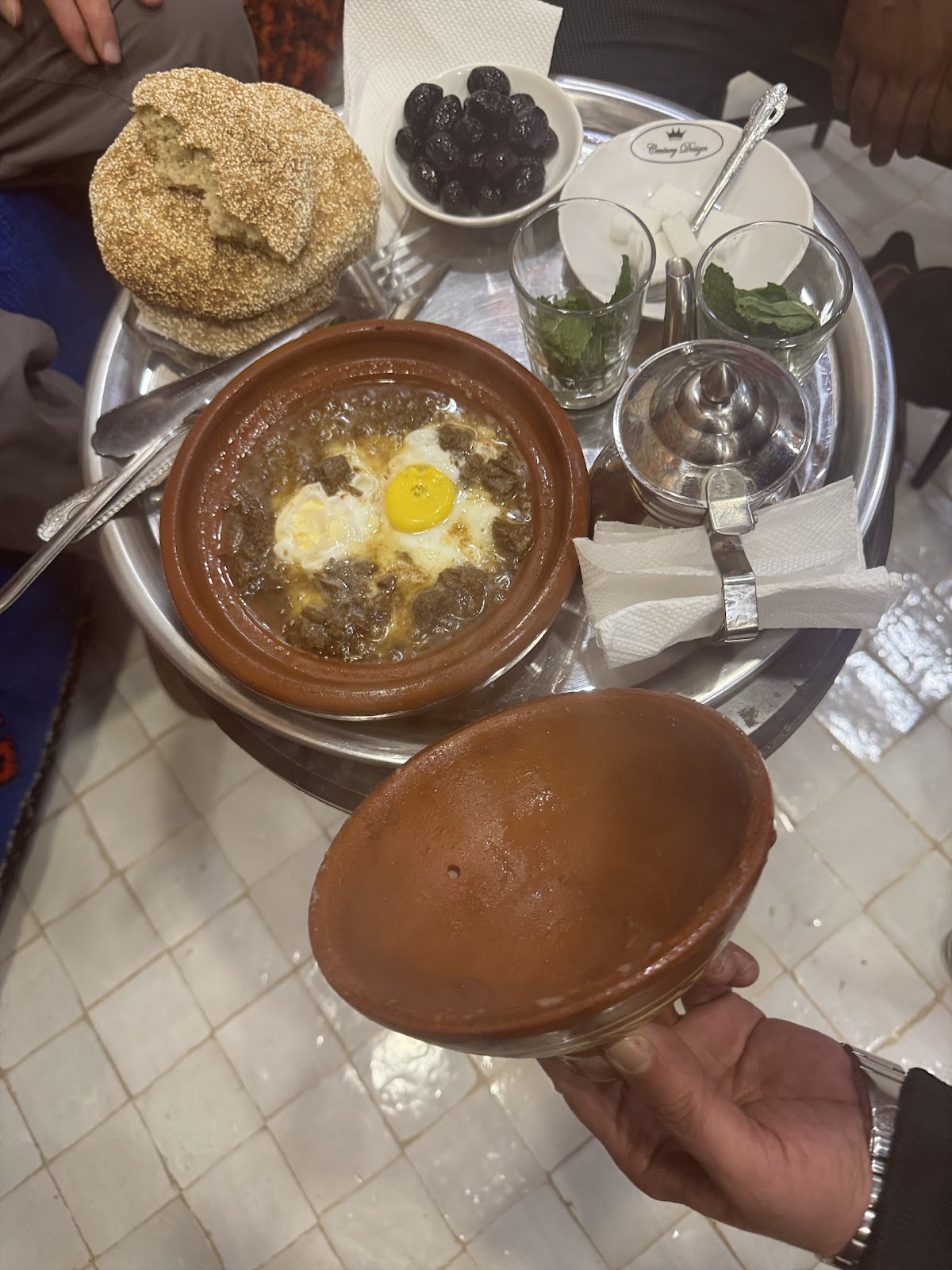
Our first stop was to a stall where the fifth-generation owners cook a high-protein breakfast soup of fava beans, olive oil and garlic on a wood-burning stove. Mostafa picked up a few rounds of barley bread to go with the soup which we ate standing while he went off to buy a few eggs, some black olives and a plastic bucket of khlea, a confit of Moroccan preserved meat. 


Making fave bean soup 

Next stop was a carpet shop where Mostafa had arranged with the owners to set up a little table for us to enjoy the meal. While we talked with the owners, he went off to have the meat and eggs cooked in a traditional tagine, a cone-shaped clay pot which Moroccans use to slow-cook meat and vegetable casserole dishes.

Our street food lunch served in a carpet shop

Street cooks start early preparing special dishes, using techniques handed down by generations of family members. Old photos in this woman's stall showed her parents or grandparents making a type of pastry dough called warqa in the exact say way she makes it today. The dough is used in a savory pie called pastilla. She rolls a ball of dough flat, then stretches it over an upturned jar that looks like a bald head that is heated underneath. The result is a thin and crispy pastry which is wrapped around the ingredients - usually chicken or vegetables - in the pastilla.


We love finding ways to connect with locals when we travel. Booking a dinner in a family home through Eatwith.com, the Airbnb of dining, is one of the best ways. A search on the website connected us with Fadila Eddaoui and Driss Mikdar who live in the Ville Nouveau, the modern town filled with high-rises, swank cafes, gardens and wide boulevards.

Avenue Hassan II in the Ville Nouveau is lined with palm trees and gardens

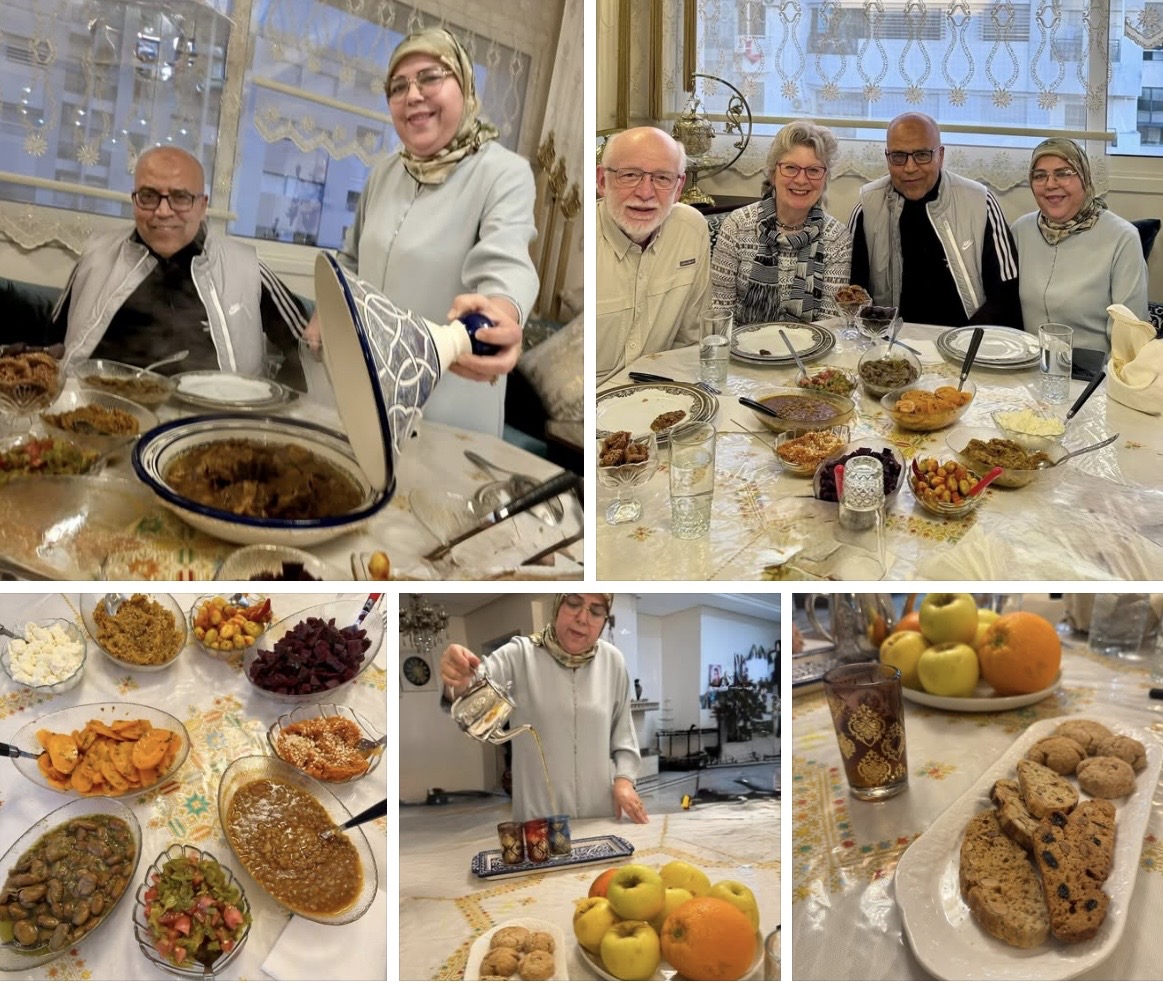
A short taxi ride from the Medina took us to their flat, a spacious upper-floor apartment where Fadila teaches cooking classes when she is not teaching French at the local middle school. Driss is a tour guide, and together, they have been working on a cookbook called A Feast in Fes available on Amazon.

Fadila uncovers her special lamb tagine 

There were too many dishes on the table to count, starting with homemade dates, honey cakes and Harira soup, and moving onto to chicken Pastilla – A savory and sweet delicacy made with layers of crispy pastry, shredded chicken, almonds, cinnamon, and saffron - followed by a slow-cooked lamb tagine accompanied by a half-dozen side dishes plus tea and homemade cookies. 

It was meal to remember but more importantly, people to never forget.


Next: On to Rabat


Our favorite pastime: Stopping for fresh mint tea available everywhere for $1.50 per glass


Oct 22, 2022

Basking in Bilbao: Edgy art, bar hopping and outdoor adventures


Bilbao specializes in pintxos, the Basque version of tapas - little snacks served with zuritos - half-glasses of beer


The Guggenheim- The big reason to visit Bilbao, but not the only one


Pick up any guidebook on Spain’s northern Basque Country, and it will point you to Bilbao to visit the futuristic-styled Guggenheim contemporary art museum designed by architect Frank Gerry. Afterwards, the advice will be to decamp to nearby San Sebastián, known for its beaches, five-star restaurants and cobblestoned old town.


Tom and I decided to reverse that itinerary, skip the beaches, and take a deep dive into Basque culture by spending four nights in Bilbao, the largest city in Basque country. Known pre-Guggenheim for its iron mines and busy port, Bilbao has undergone a renaissance since the museum was completed in 1997. Still, it goes largely undiscovered by day-trippers. 


The museum’s design and riverfront location do impress. We visited on our first afternoon in town, riding the city’s efficient metro a few stops from our hotel in the historical center, and timing our visit to two hours before closing to avoid crowds.


Inside the Guggenheim 


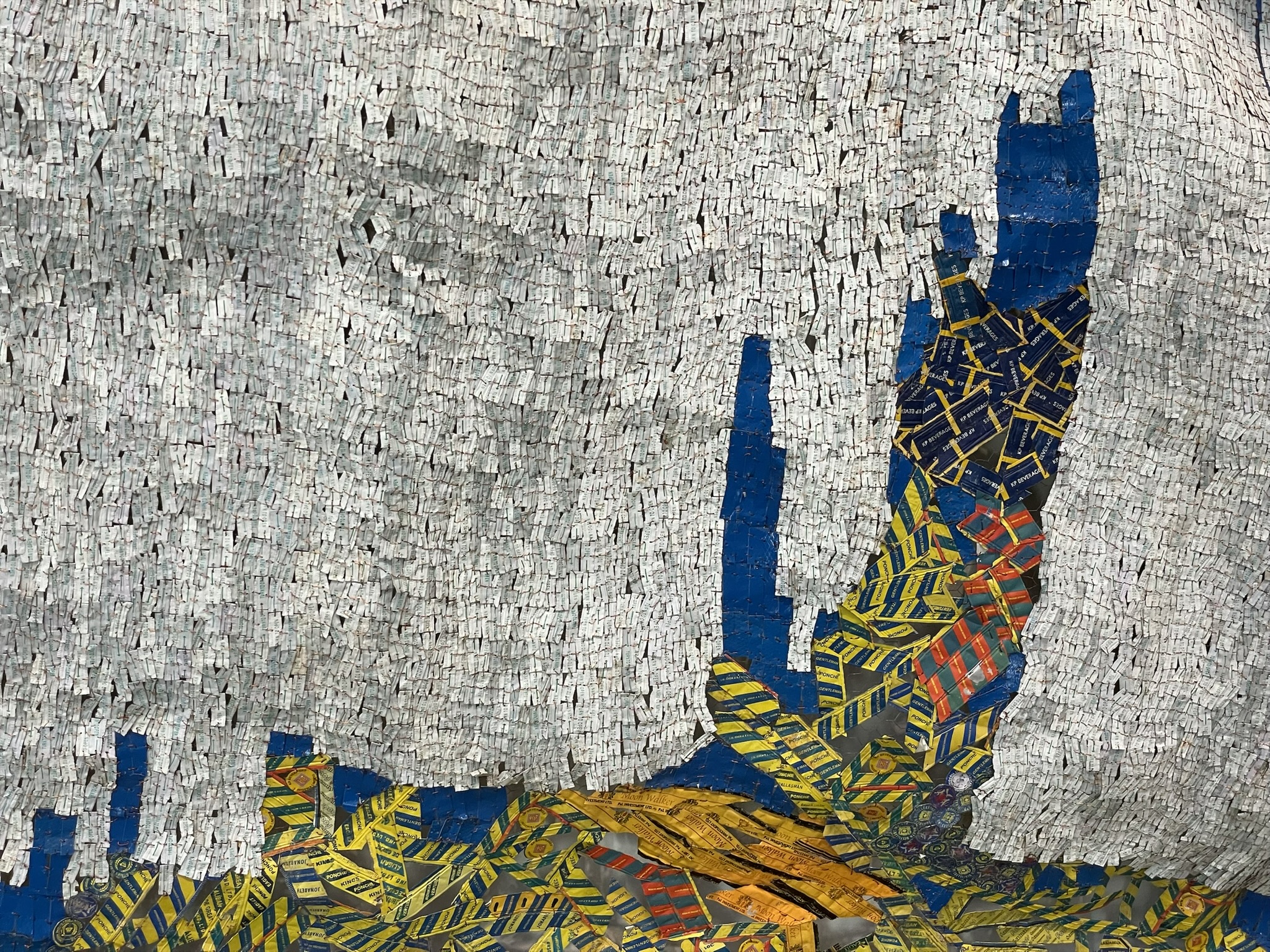
 Most find the exterior and interior design elements more interesting than the art exhibited inside. We agreed, with one exception: The artist created this wall-length piece entirely from scraps of tin, bottle caps etc., and hired Nigerian helpers to stitch it together with copper wire.


Balconies with glass-enclosed sun porches grace buildings in  Bilbao’s medieval town center


Bilbao is split along two sides of the Nervion river. Walking paths along both sides replaced former docks in what in post-pandemic 2022 has become a compact and highly-pedestrianized city with a charming old town, an edgy arts district, and a skyscraper-filled new town with bars and restaurants on every corner.


Mercado de la Ribera

We spent most of our time in Casa Viejo, the 700-year-old medieval town center on the river’s right bank. One that side is the Art Deco-style Mercado de la Ribera, a covered market built in 1929. Opposite the market, on the other side of the river, is a scrappy but gentrifying quarter where much of the city’s former iron mining was located. Street art, chic cafes, and even a Michelin-star restaurant. Bridges connect the two sides of the river at various points.

Peppers of several varieties dominate this mural on Bilbao’s  left bank


 Clotheslines come with umbrellas for protecting hanging laundry from the rain

A historical marker in Spanish and Euskara , the Basque language that pre-dates Romance languages 

The Basque people come from a region of southwest France and northwest Spain. They have their own language and cultural traditions. Some favor independence from Spain, but the separatist threats of past years have largely been replaced by show of nationalistic pride.

Culinary traditions are strong. Mountains of sweet peppers, and fresh tuna and cod from nearby fishing villages create toppings for pintxos that appear on the countertops of bars starting mid-morning until late night.

Markets overflow with sweet red bell peppers 


Padrone peppers are served roasted and salted. Most are mild, but one in 10 could be hot. You eat the whole pepper in one bite, except for the stem

A pintxos meal

Ordering pintxos from busy bartenders requires quick decisions. Platters appear on the bar as they come out of the kitchen. You point to what you want, indicate how many, order a drink, pay, Then, if you’re still hungry, you come back for more, We made meals of pintxos most nights instead of ordering full dinners. The snacks are often paired with little half-sized beers called zuritos. The idea is that you can bar hop from one place to another, sampling different pintxos, without drinking too much at each stop.

Bilbao’s signature dessert, the Carolina (pronounced Caroleena as in “Little Carol”). Of course, I had to try it. The Carolina was invented by a pastry chef whose young daughter loved meringue. To make it easier for her to eat, he filled a miniature pastry crust with a cone of meringue, and glazed it with egg yoke and dark chocolate. Carolinas are best eaten with a spoon, and paired with a cafe con leche (latte) served in a tall glass.

Carol with a Carolina


 Cafe con leche 


Bilbao is surrounded by incredible natural surroundings. The metro connects the city with a string of beach towns within a 30-minute ride.  We traveled to one perched high above the water, found a path down through the village, and a funicular to take us back up for 20 cents. Just 10 miles inland from the Bay of Biscay on Spain’s Northern Coast, the area is considered one of the world’s top surfing locations. 

The bay also is the location of San Juan de Gaztelugatxe, a 10th century island hermitage dedicated to St. John the Baptist. Some might recognize it as “Dragonstone” from Game of Thrones. 

The walk to Dragonstone


Local travel agencies offer day trips for those without cars. We signed up for a morning bus excursion that included a hike to a monastery at the top via 241 steps along a zig-zag path that reminded us of the Great Wall of China. 

The view from the top

The 1.7-mile round-trip walk took about 1.5 hours, and was not as hard as it sounds. There were around 25 people on our bus, and most everyone made it up and down in about the same amount of time. The reward: fantastic views of the bay in both directions.

By the way, in my previous post about Porto in Portugal, I mentioned that almost know one was wearing masks. It’s a different story in Spain where the law still requires masks on public transportation including planes. Everyone complies.

For more pictures and stories, see Tom’s blog at https://puciello.com/wp/2-hello-from-bilbao-spain/#jp-carousel-4369


Sep 29, 2022

Porto, Bilbao and other stops along the way to post-pandemic overseas travel


Despite nagging uncertainties about Covid, tales of crowded airports, lost bags and high prices, strategic planning may be all the travel insurance you need for successful overseas travel this fall. 

That's what I'm finding as Tom and I put finishing touches on our second European post-pandemic trip this year, this time to Porto in Portugal; Bilbao in Spain; a few days with friends at their rental house in southeastern France; and some time in Paris.

This is what I call  "tame" travel, nothing complicated and no third-world destinations. That saddens me a little since our last trips before Covid were to Egypt, Uzbekistan and Myanmar. There will come a time for more adventuresome travel again, but Covid is still with us no matter how hard we'd like to wish it away. So for now, we're sticking to areas that carry fewer risks, making no non-refundable upfront payments, and honing in on new cities and experiences while avoiding crowds and crowded airports.

The plan starts with what's called "second tier" cities - large cities that don't include the busy capitals.

Port in Porto

We've been to Portugal only once, and to Spain a few times, but never to Porto, the transportation hub of the wine trade for which port wine got its name. Harry Potter author J.K. Rowling lived here between 1991 and 1993, inspired by visits to the Lello bookstore and Majestic CafeAlso new to us is Bilbao, the urban, riverside hub of Basque country, a culturally unique area between southern France and Spain. 

When it comes to avoiding the hassles of major airports and tourist crowds, flying directly into  a smaller city is always a good move. Many are surprised to find that this is fairly easy to do from the U.S., given the availability of non-stops to European hubs such as Amsterdam, with onward connections to cities such as Florence in Italy instead of Rome or Milan, or in our cases, Porto instead of Lisbon.

No need for travel insurance to cover the airfare because it can be cancelled or changed without penalty, a policy most airlines instituted during Covid, and so far have not walked back. 

Finding accommodations with liberal cancellation policies has also been easy.

Since Covid, Airbnb has convinced most of its owners to offer fully refundable bookings within a few days of arrival. 

The pedestrian Rua das Flores

For our first three nights in Porto, we booked a lovely studio with a balcony overlooking Rua das Flores, a pedestrian street lined with 17-19th century buildings that once housed wealthy merchants. The price was a reasonable $125 per night, refundable up to five days ahead. 

The same policy applies to an $85-a-night Airbnb apartment we rented in Pinhao, the center of the port wine trade in the rural Douro River Valley, and  a six-room B&B ($110) back in Porto's Riberia historic district booked for our last three nights.

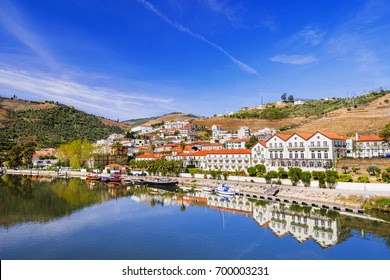
Pinhao in the Douro River Valley

Also changeable and refundable (for a credit) were our flights to Bilbao and Paris purchased online on Vueling Airlines, a low-cost Spanish airline.

With all the talk about inflation in Europe, American travelers may not find prices as high as expected, due to the strong dollar, now one-to-one with the euro.

The one place we did encounter sticker shock was in first-tier Paris where the price of the hotel room I booked in 2019 went up from $90 to $150. We could have looked harder, or just paid the price. But since we'd been thinking about taking a bike tour around Versailles, a wealthy suburb that King Louis X1V made the French capital from 1682 to 1789, we pivoted to a homey B&B there instead for $110 with breakfast. 

Putting together your own trip vs. taking an organized tour is more work, of course, but the rewards are independence and flexibility. Still, it's often easier to rely on someone else for short excursions that involve complicated transportation logistics or having a car. 

For these types of day trips I turn to "GetYourGuide," a Berlin-based online travel agency and marketplace for excursions offered by tour companies worldwide. There's no advance payment, and cancellations are generally allowed 24-48 hours before departure.


The Pavia Walkways near Porto

It's here I found a day trip from Porto by mini-van ($90 each) to the Paiva Walkways, a four-mile boardwalk zig-zagging through a geopark on the the left bank of Paiva river. It also includes a side trip to the   516 Arouca Bridge, a 1,692-foot metal suspension bridge suspended 576 feet above the water; lunch; and a boat ride along the canals of the nearby town of Averio. The tour company observes Covid precautions such as requiring passengers to wear masks, and takes half the usual number of people in its vans.


Gaztelugatxe Island

A similar excursion in Bilbao ($60 each) will take us to the island of Gaztelugatxe where a 10th-century hermitage is connected to the mainland by a bridge and 240 stairs. Some will recognize it as the island fortress of “Dragonstone” from season 7 of Game of Thrones.

Many Airbnb hosts offer activities such as bike trips and food tours. Filter for "experiences" to see what's offered in various cities. Eatwith.com offers opportunities to dine in the homes of locals. Sadly, we'll miss the chance for a traditional salt cod dinner in Porto because the Portuguese/Serbian hosts will be on vacation. 

Some independent travelers hire private guides, but for my money,  free group walking tours offered through websites such as Freetour.com and GuruWalk, are just as informative, and often more fun. The upbeat guides are often knowledgeable students or professors who work for tips. In Porto, we signed up for two free city walks offered by Porto Walkers which also offers paid port wine and food tours. 

in Bilbao, Freetour's 2.5-hour walk includes recommendations on where to sample the best traditional and modern “pintxos,” the Basque version of Spanish tapas.  Susana, a guide from GuruWalk who describes herself as someone with a "Greek passport and Basque heart," leads small groups through Bilbao la Vieja, a former industrial area which she calls the Soho of Bilbao.

We couldn't decide which of the walks to do, but the price was right, so we signed up for both.