Showing posts with label Middle East. Show all posts

Apr 18, 2026

Malta in the Mediterranean: Where Arabia meets Europe


Built from limestone, Malta's capital city of Valletta glows in the Mediterranean sun 


We're not beach people. Nor are we all that interested in military history.

So why will we be soon visiting Malta, a handful of tiny islands in the Mediterranean between Sicily in Italy and Tunisia in North Africa? It‘s a country mainly known for its summer resorts, its history as a strategic military site during World War II, and the place where Catholic crusaders defeated the Islamic Ottoman Empire in the 1500s.

Our decision started with a search for a new destination to explore with convenient connections to Bari in Southern Italy where we plan to visit friends in the town where my grandfather was born. 

A Ryanair flight to Bari from the Maltese capital of Valletta popped up on Google Flights around the same time I spotted an article titled "There's more to Malta than Beaches."

"Where Arabia Meets Europe" is how Saudi AramcoWorld Magazine described Malta in its February issue. A confluence of cultures - Greek, Roman, Arabic, Sicilian, Spanish, French and British - gifted Malta with a blend of culinary traditions, architecture and a semitic language in the same family as Arabic and Hebrew, with phrases adapted from French and Italian. 

I booked the Ryanair flight.

Malta in the middle of the Mediterranean

Getting a handle on Malta's geography is tricky. The country includes five islands, three inhabited, dominated by steep limestone cliffs indented by bays, inlets, and coves. Deciding where to base ourselves for six nights was the first challenge

The most obvious choice is Valletta, the European Union's smallest capital filled with 16th century Baroque-style buildings built by the Knights of St. John, a Catholic brotherhood, founded in Amalfi, Italy in 1048. Called the Knights Hospitaller, they originally provided a nursing hospital for sick pilgrims in Jerusalem, but later took on a military role fighting Muslim invaders during the Crusades. 

Following the reconquest of the Holy Land by Islamic forces, the Knights moved on to Greece where they were later expelled by the Ottomans. Searching for a new base, they accepted an offer from Roman Emperor Charles V to occupy isolated and sparsely-populated Malta for the price of a single Maltese falcon.

The backstreets of Birgu

The Knights settled in Birgu, a city on a peninsula stretching out across the harbor. Following the1565 Great Siege when the Knights and Maltese civilians successfully halted the Ottoman expansion in the Mediterranean, the Knights' leader, Jean de Valette, set out to build a new heavily-fortified city across the harbor from Birgu to be called Valletta. 

Built entirely of golden limestone, it developed into a center of Baroque architecture, featuring grand churches, monasteries and gardens. 

St. John's Co-Cathedral, a Baroque showpiece built by the Knights of St. John in 1573.


After looking for places to stay in Valletta and finding them either booked or expensive, we  decided to base ourselves in quieter and less-congested Birgu. Our Airbnb ($130 per night) is  an air conditioned apartment in a  renovated 300-year-old townhouse  a short ferry or bus ride across the water from Valleta. Pictured below is the exterior of the apartment with a gallarija, a traditional Maltese enclosed wooden balcony, an Arabic-inspired feature designed to offer with privacy, ventilation, and a view of the street.

Birgu also happens to be the best location to view the Malta International Fireworks Festival, usually held after Easter, to mark the start of the summer fireworks season. The country has deep pyrotechnic traditions dating to the time of the Knights who celebrated military victories and important religious events with gunpowder displays. This year's festival finale, capped by 1,000 drone show, will be happening while we are there. Tickets are already sold out for viewing areas with seating, but our Airbnb is right next door, so it looks like we will have front-row seats by default.


Airbnb in Birgu's Medieval quarter


Buildings with Arab-style enclosed balconies 

We hope to explore other areas beyond the usual guidebook recommendations with the help of a few walking tours and a 7-day bus pass good for unlimited rides on Malta's excellent transportation network. We'll use an Airbnb Experiences' three-hour street food tour to get acquainted with Maltese cuisine, and plan to visit the main food hall called-Suq Tal-Belt, Suq, taken from the Arabic word for "marketplace." .

Traditional Maltese coffee is blended with chicory, ground cloves and aniseed

Bloggers with YouTube videos point visitors to local neighborhoods within walking distance of  Valletta. One is Hamrun, a neighborhood the AramcoWorld story described as a multicultural mix of immigrants, ones who have lived here for decades and those who can trace their lineage back centuries. Here, the story said, visitors will find  "a pan-African shop of goods called Inshallah Mini market is sandwiched between a Catholic church and an Afghan restaurant. Just a few blocks down, past a diner sporting American flags and the Australian butcher, is a Syrian-owned nut shop." 

As for our Ryanair flight to Bari, there's a risk it could be cancelled due to fuel shortages caused by the U.S. war with Iran. There are other flights, so the worst that could happen is that we would have to an extra day in this surprising country. Maybe even hit the beach.


Sep 23, 2024

Off the grid in Safronbolu on Turkey’s Black Sea Coast


Safranbolu

Turkey’ Black Sea Coast – from the northern end of the Bosphorus just east of Istanbul to the frontier with Georgia - is off the radar for most people other than Turks.

There’s lots to explore, from mountain villages and ancient monasteries, to seaside towns, with fewer crowds than the more well-known Mediterranean or Aegean destinations, but figuring out where to start is a challenge if you don’t have a car. 

There are easier places to begin than the town of Safranbolu in the far northwest corner, but I had my heart set on spending time here from the beginning. 

Nestled in canyons, surrounded by mountains, and away from  the coast itself,  it is not on the way to anything, but in Ottoman times, it was an important stop on the Silk Road trade route between China and the West. Traders came for the saffron, and created a town that retains its cobbled streets, mosques, bathhouses and traditional inns built between the 13th and 17th centuries. More than 2000 18th and 19th century historical homes called konaks, fill the historical center today, some lived in by locals and many transformed into guest houses, hotels, restaurants, shops and cafes. 


Evening in Safranbolu

And so, the decision was made. After mentally nixing Safranbolu from our itinerary several times due to the hassles of getting in and out, we dug in and committed to a six-hour bus ride from Istanbul for a three-night stay. It will take another three hours to get out and onto our next stop.

These days when you Google a destination for travel information, a list of frequent questions pop up such as “Is Safranbolu worth going to?”

I give it a big Yes. For Turks, it‘s a tourist town, a weekend getaway. They come to eat in the restaurants, and shop the local bazaar for tiny jars of saffron, gift boxes of Turkish Delight and colorful bottles of flower-scented cologne. 

It‘s always time for tea in Turkey

For visitors like us, it‘s a place to immerse ourselves in a part of Turkey where little English is spoken, where we can walk everywhere, and stay in  a welcoming konak with a 250-year-old history.

No car. No problem. The owner of Gunes Konak guesthouse picked us up at the bus station (We communicated on WhatsApp using Google Translater). Our second-floor room, on a hill overlooking the town, has a modern bath and shower, but also creaky floorboards, crooked doorways and wooden window latches. 

There’s a prayer rug stashed in the corner and a tiny arrow point to Mecca on the ceiling. The local mosque plays the Call to Prayer over loud speakers at inconvenient times. 

It’s all about becoming part of a neighborhood for a few days where a simple “Merhaba” (Turkish for hello) goes a long way.

Gunes Konak guesthouse

Our Turkish neighbors. A simple “Hello” in Turkish produces smiles

The $70 rate includes breakfast prepared by three women busy in the kitchen before 8:30 a.m. Waiting for us are platters of olives, cucumbers, tomatoes and cheeses; fresh bread; four types of homemade jam; fried eggs sizzling in a copper pan; a Turkish version of French toast; a roasted pepper and olive spread; and endless glasses of steaming Turkish tea. 

Breakfast platter with Simit, a circular bread encrusted with sesame seeds.

In 1994 Safranbolu was placed in the world Cultural Heritage list by UNESCO in appreciation of the efforts towards preservation of its heritage as a whole, but especially its traditional houses, reflecting the Turkish social life of the 18th and 19th centuries. 


The size and the planning of the houses were determined by the large size of the families. Uniformly made with white stucco, brown shutters and red tile roofs, most are are two or three stories, with delicate woodwork and carved wall and ceiling decorations. They were built to line up so as not to block each other’s light, prompting architectural historians to characterize them as early examples of socially responsible building design.

The whole town is walkable, but the narrow streets are steep and laid with rough stones. Most people come here with cars. 

Logging lots of steps

The city’s name comes from saffron which is native to Safranbolu. We will just miss the annual autumn harvest when fields will be covered with purple flowers. These days, more saffron is imported into Turkey than exported, but the government is taking steps to encourage more production. Our B&B host recently planted a small saffron garden for his guests.

Saffron for sale in the bazaar 

Small jars of real Safranbolu saffron sell for around $10. Some sells for less, but we were told it comes from Iran.

Turkish Delight is shaped like a rope, then cut into bite-sized pieces 


Turkish Delight or Lokum is another sought-after local treat. Every shop employs someone to stand outside with a tray of free samples. Based on a gel of starch and sugar, it comes in many flavors, including saffron, Turkish coffee and Oreo. Safronbolu‘s version is said to be unique due to the town’s hard water.

Bakers, blacksmiths, shoemakers and coppersmiths also contributed to the economy in the past. A few still ply their trades in back alleys, but most of the traditional workshops have been replaced by souvenir stalls. Our neighborhood has its own simit baker. It’s fun to watch as he shapes his dough into circles before baking it in a wood-fired oven.


Our favorite building is the Cinci Han (inn)  built in 1640 as a caravanserai - a way station for traveling traders. Restored in 2004 as a hotel, it is made completely out of stone. 

A coffee museum runs a cafe on the second floor overlooking an open courtyard. Here you can sample various kinds of Turkish coffee, served elegantly on little gold platters along with small glasses of juice and a square of Turkish Delight.  


All this for half the the price of a Starbucks latte. Naturally, we have become regulars.


Next stop: Trabzon

May 6, 2023

Ancient, modern Amman provides visitors soft landing in Middle East


A juice vendor in downtown Amman

Leaving our hotel with just a few hours sleep after a late-night flight from London, my husband, Tom, and I stepped out onto the streets of Jabal al-Weibdeh, a gentrifying hillside neighborhood in Amman, the capital of Jordan. 

The minaret next to a blue-domed mosque towered over neat rows of sandstone-colored houses and apartments. Cafe owners dusted off their patio tables. Springtime flowers bloomed in sidewalk gardens.

It was just 9 a.m. but already warm and sunny. We were headed out for a walking tour in downtown Amman - the oldest part of one of the oldest cities in the world - when I spotted a corner store. Before I could ask, the man behind the counter pointed to a cooler filled with bottled water.
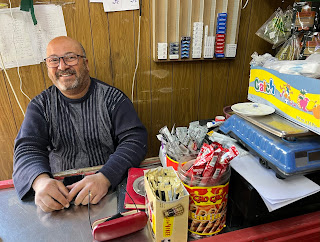
"Welcome, welcome," said the owner of our neighborhood store

“Small, small,” he smiled, holding up a coin - the Jordan dinar equivalent of around 25 cents - indicating he couldn’t make change from the large bill I offered. 

“No problem. Free for you,” he said, refusing my offer to pay him later in the day. “Welcome, welcome.”

And so began our first day in Amman, a city continuously inhabited for 7,500 years, yet the capital of a country that only gained its independence from the British 77 years ago.

Located between Mecca, the holiest place on earth for Muslims, and Jerusalem, Jordan has played a central role in the history of the Old Testament (Moses and Abraham walked here); the Bible (St. John the Baptist baptized Jesus in the Jordan River); and the Quran.

Yet while almost everyone is familiar with Petra, Jordan's major archeologic site; Wadi Rum, a desert valley area popular with rock climbers and hikers; and the experience of floating in the Dead Sea, few stay in Amman long enough to appreciate the most liberal city in the Arab world, and likely the most diverse.
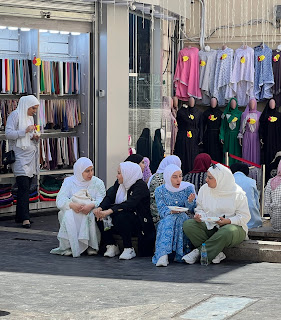
Women who wear head scarves wear them in style

Bordering Syria, Iraq, Saudi Arabia, the Palestinian territories and Israel, Jordan is predominantly Muslim with a large Palestinian population. It also has a significant Christian population, so it's not unusual to hear the Call to Prayer at a local mosque and church bells ringing at the same time. Cafes stock beer and wine for those who drink alcohol, and tea and shisha pipes for those who abstain. Head scarves for women are optional. Call it Middle-East Lite.  Amman provides a soft landing for first-time visitors in the Arab world. 
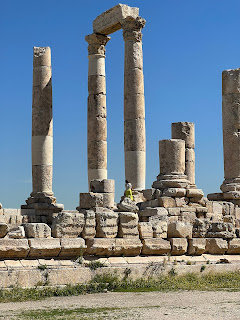
The Temple of Hercules

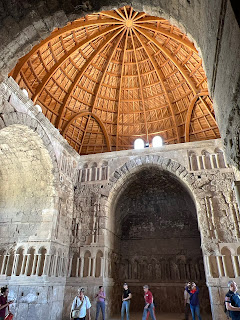
With 4.5 million people, Amman's city limits stretch far beyond the original old city built on seven hills or jabals. Towering over everything is the ancient Citadel with the ruins of the Roman Temple of Hercules and the Umayyad Palace complex built during the 8th century on the foundation of a Byzantine church. Next door is the Amman Citiadel mosque with a restored domed entrance chamber.
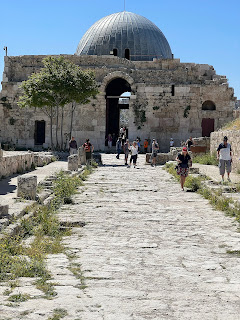
The Amman Citadel Mosque


The original mosque is believed to have had a wooden dome, like this one which was constructed towards the end of the 20th century.

Downhill  and a five-minute- walk to downtown are the remains of a 2nd-century Roman theater when the city was known as Philadelphia. The theater is still used for sporting and cultural events.

Getting around foot requires a steep climb up or down connecting staircases, often hidden from view but marked on Google maps. 
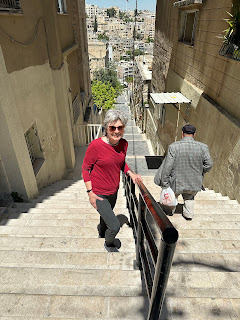
Stairs to downtown


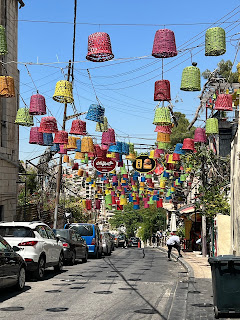
A street decorated with colorful lanterns

Using as our base the Locanda Boutique Hotel, a cultural project where the names of well-known Arabic musicians replace room numbers, we devoted our time to exploring Al-Balad, the Arabic name for the old downtown and Jabal-al-Weidbdeh, the cultural heart of Amman, with its art galleries, museums and vibrant cafe life. 
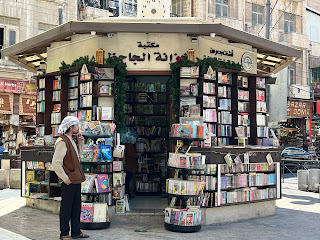
Downtown bookshop

Around town with Osama


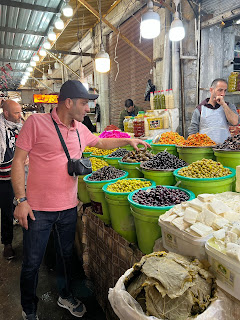
Osama explains the many varieties of olives for sale in the vegetable souq

Nine of us - all strangers before today - follow our guide, Osama, as he leads us across a busy street, stopping traffic by holding out his left hand. We’ve signed up for his “Taste of Amman Free Food Tour” through GuruWalk.com, a clearing house for locals who create walking tours in cities throughout the world. Tips are encouraged, but there’s no obligation and no set prices.
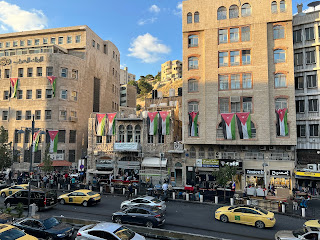

Downtown Amman


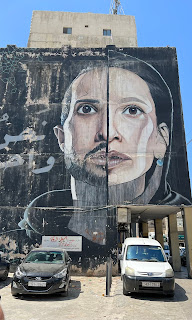
One of many downtown murals

We'll soon be weaving in and out of the souqs - an ancient labyrinth of covered markets for fruits, spices, vegetables and clothes. But first we stop in front of a mural depicting a face divided vertically down the middle, half male and half female. It's a statement about equality among the sexes in a commercial area lined with shops all run by men. 

This mural and many others like it painted on the walls of businesses and buildings around Amman are meant to encourage dialogue on gender issues Some of it is aimed at correcting a mismatch between attitudes towards women working (90 percent of men and women approve) and the low percentage of women (14 percent) in the workforce. 

Female literacy rates are among the highest in the Middle East, and more women than men are enrolled in college. But leaving children with a relative in order to to work is still considered unacceptable as is having a job that requires late hours and time away from a family.

“We don’t have oil,” Osama explains. “So we need to invest in human beings.” 

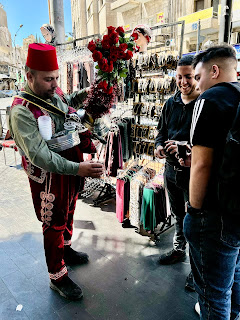
Our first stop is the oldest bakery in Amman where fresh loaves are stacked under a sign written in Arabic. Then we plunge deep into the crowded souqs stocked with vegetables we don’t easily recognize and shops where bins are piled with artfully displayed spices, teas, olives and almonds. 
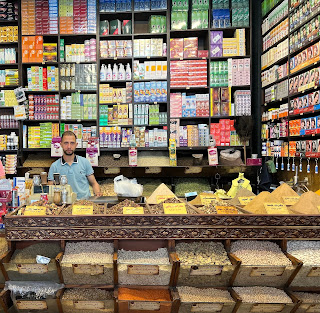

Spice souq


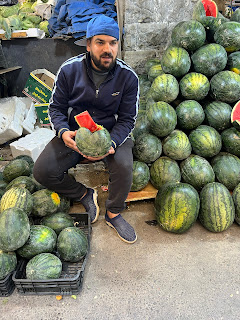
Watermelons for sale: $1.50


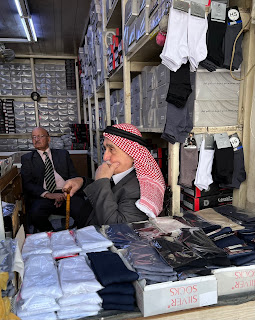
Socks and underwear salesmen

At the top of one flight of stairs is the Dar Al-Anda art gallery, housed in two historic villas with an outdoor terrace and sweeping views. Another stairway leads to a little cafe that serves mint and lemon juice and sandwiches made with za'atar, a spice mixture made with toasted sesame seeds, dried sumac and other herbs, that Osama promises "is good for health and the brain."  

Za'atar sandwich on the terrace of Dar Al-Anda

At the bottom of those steps, we take special note of  the location of Habibah sweet shop across the street. The specialty is Kunafa, a layered dessert with a base stringy cheese similar to a mozzarella and the top layers of vermicelli soaked in rose scented sugar syrup. Clerks in white coats cut slabs from a pizza-size pan, weigh the slices, and charge accordingly. 
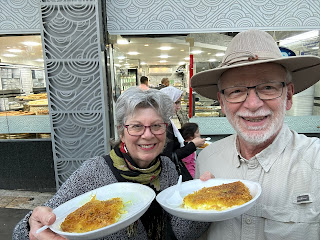


Kunafa at Habibah sweet shop

After two-and-a-half hours of waking and a stop for bottles of Jordanian beer to-go, Osama leads us up a long flight of stairs to his home where he has prepared lunch for our group. This part of his tour was not advertised on the Guruwalk website. Rather he informed us in an e-mail after we signed up that lunch would be included. Dietary issues forced him to learn to cook healthy foods at a young age, he explained. Those skills led to a job as a chef at a hotel in Petra before he became a freelance guide. 

As we take places around his dining table, he retreats to his kitchen, and reappears with appetizers called mezze- bowls of homemade hummus, yoghurt, baba ganoush, a peasant salad called fatoosh and baskets of pita bread. Restaurants all over Amman serve their own versions of these dishes. Guidebooks point visitors to a crowded downtown spot called Hashem, but Osama's recipes are better, and there's no wait for a table. 

We could have made a meal of the mezze, but there was a main dish to come, and one Osama was very proud to have mastered. It's Maklouba, a dish found a 13th century collection of Arab recipes,  popular throughout the Middle East.
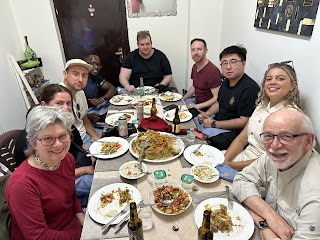
Our walking group at lunch

Vegetables such as carrots and peppers and chicken or lamb are folded into a mixture of rice and 13 spices. It's all piled into a pot and cooked over the stove, then tipped upside down on a plate revealing the layers of chicken, rice and vegetables. 

Osama brings the pot to a side table, inverts a perfectly intact Maklouba, then places the platter in the middle of the table for us all to devour.

"Welcome, welcome," he says. We remember what he said earlier about investing in people, and leave a generous tip.
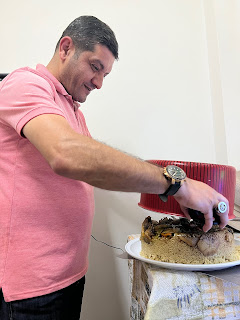

Osama inverts his Maklouba


Apr 16, 2023

London to Jordan: Where to find travel info during post-pandemic times


London's new 'Lizzy' Line

Who hasn't done some online shopping only to find "Suggested for you" link popping up on their Facebook page a few days later? This type of tracking seems pointless. If I already bought the shoes, why would I need another pair? But in planning a short stay in London before traveling to Jordan, the otherwise annoying prompts have proven useful.

The latest was a post about the new Elizabeth Line, opened in May of last year, providing Heathrow passengers a new public transport option for getting into the city.

"Twenty billion pounds. Two new tunnels, bored for twenty-six weaving miles, under the streets. Ten new stations, with platforms and trains twice the length of standard Tube trains, excavated and somehow placed alongside or under the existing network," according to a New Yorker description.

It's been three years since I've been to London, and I'm finding the usual sources for information - guide books and Trip Advisor reviews - outdated due to the Covid pandemic. 

Gilbert & George

That's where the Facebook links to news outlets such as Time Out London and CNBC and others have come in handy. I now know to take the "Lizzy Line" (£12.80 vs. £25 for the Heathrow Express to Paddington Station) directly to a tube stop closer to our Airbnb. Also new on my radar is the Gilbert & George Centre, a just-opened free museum featuring the Andy Warhol-like art of a well-known duo, now in their 80s; the Uber Boat, a commuter boat stopping at 24 piers along the Thames River that doubles as a budget sight-seeing cruise for travelers-in-the-know; and Secret London, a website filled with ideas for new discoveries. 

Finding ways to keep up on the latest trends and changes can be challenging when it comes to diving back into international travel. 

Airbnbs, for instance, have replaced traditional bed and breakfasts as affordable alternatives to hotels, but you won't find reviews or information on them in guidebooks or on Trip Advisor. 

Blogs, Youtube videos, and yes, even Facebook posts, have become more useful tools. AI sites such as ChatGPT will evolve once they begin to include more current data. Posts by young travel bloggers helped me uncover the latest info on paying for transport with contactless credit cards or mobile systems such as Apple Pay.  A few years ago, the pre-loaded Oyster Card was the preferred way to pay for London transport. Most locals no longer use it. This post explains why.

Here's a few more new resources and tips I uncovered while putting together our upcoming trip.

Avoiding non-refundable reservations

Travel insurance is tricky and expensive, but sometimes necessary if you're booking a cruise or other non-refundable types of travel. Check to see what type of coverage your credit card might offer (some, such as Costco, are dropping coverage) before buying an independent policy, but better yet, avoid non-refundable bookings when possible. Covid showed us how quickly things can change.

I searched for an Airbnb rather than a hotel or bed and breakfast in London, not only because they are often more affordable, but because many have a liberal cancellation policy. Our $125 room with a private bath near Victoria station offered a full refund within five days of arrival. Most B&Bs wanted at least a partial non-refundable upfront payment at the time of booking. 

Post-Covid, most U.S. airlines have retained a policy of allowing cancellations and/or changes with no penalty. You won't get a cash refund, but most offer a credit that can be used another time. 

This doesn't apply to some foreign airlines. Our round-trip flight between Seattle and London,  booked on Delta, could be changed or cancelled without a penalty. But a separate ticket on British Air between London and Amman, Jordan was non-refundable. On the other hand, our hotel in Amman, La Locanda Boutique Hotel, took no deposit.  A three-day van excursion from Amman to Petra, Wadi Rum and the Dead Sea, booked through Get Your Guide, was fully-refundable up to 24 hours ahead of departure.


Youtube videos

Youtube videos put together by tech-savvy travel bloggers can help travelers get the lay of the land before arriving. I'm hooked on blogger Mark Wiens' food and city video tours available on his Migrationolgy website. His in-depth reports cover destinations such as Amman, Dubai, Bangkok, Singapore, Lisbon and Mexico City, each with multiple videos beginning with his arrival in a city and ending with his last meal. 

Free or low-cost tours

Looking for a day-trip or short excursion away from a major city that would normally require renting a car? Consult Get Your Guide, a clearinghouse for short and inexpensive van or walking tours in cities all over the world. No payment is required upfront, and nearly all can be cancelled within 24 hours of departure with no penalty.

Private guides can cost $100 or more for a few hours of time, but there are many free or low-cost alternatives if you don't mind going with a small group led by a student, teacher or  sometimes even a professional guide hoping to drum up business on the side.

We booked an afternoon food tour in Amman with GuruWalk that combines a historical walking tour with stops for traditional snacks along the way. It ends with a meal fixed by the guide in his home. There's no charge for the tour. Guests pay for whatever food they order. As always, a tip is expected, but there's no obligation on the amount.  You'll find similar walking tours offered by Freetour.com in various cities.  

Snacks on the GuruWalk food tour in Amman


The walking tour I'm most looking forward to is a meet-up in London with Julia Gay, a volunteer with London Greeters. The group is part of the International Greeters Association,   volunteers who love showing visitors favorite parts of their cities. We'll meet up at the Liverpool Street train station for a walk around London's lesser-known East End, with stops in Spitalfields and Brick Lane, known for its Sunday market and Bangladeshi community.