Showing posts with label Mexico. Show all posts

Aug 31, 2026

Ignore the Airbnb pushback; Choose wisely and everyone wins


An Airbnb in Taxco, Mexico. The owner lived next door

Should you feel guilty about staying in an Airbnb, given the pushback around the idea that they displace locals, create a shortage of housing and ruin neighborhoods once reserved for long-term residents?

Hotel industry lobbyists are winning support from city governments to restrict or eliminate Airbnbs in many places. Even consumer advocates, such as syndicated columnist Christopher Elliott, urge travelers go back to being tourists rather than "pretending" to live in a neighborhood at the expense of permanent residents."

I argued against those arguments in a recent blog post countering the assumption that Airbnb lost its way when it began opening up its listings to investors with hired managers. Some are, but many are owned by individuals supplementing their incomes by renting out a room, suite or mother-in-law apartment never intended as a full-time residence. 

 "How do you tell the difference?" a reader asked.

A classic Airbnb on Salt Spring Island in British Columbia

Making the right choice when choosing an Airbnb requires research, not only when it comes to ownership, but also the neighborhood, bottom-line price and refund policies. Do your homework, and you won't need to feel guilty about deciding on a spacious Airbnb as opposed to a tiny room in a high-priced hotel. The bonus is not only a larger, more private accommodation, but the chance for a unique cultural experience, especially if you are booking in another country,

Here's what to consider:

After searching for a listing that meets your criteria, scroll down to below the map showing the location to "Meet your host." My husband and I rented a suite in White Rock, British Columbia recently. The owner and her family lived in a house attached to the unit which appeared to have been remodeled to include a kitchen, bathroom and bedroom. The entrance was near the back of her house, and although the unit was well-equipped, I doubt that anyone would find it suitable as a full-time rental.

A typical Airbnb listing with photos. This was our White Rock Airbnb


A unit that is not owned by an individual but rather by a company that hires out the management might list their own name or the names of the same two or three different "hosts" on multiple listings. 

The studio apartment we rented a couple of years ago on Rua das Flores, the main pedestrian street in Porto, Portugal was one of several managed by the same people, a good indication that the owners were investors. The host, Sofia, confirmed she was a real estate consultant who, along with her parents, started buying up units on the street a few years ago.

The view from our Airbnb in Porto

We stayed three nights in the Airbnb and two nights in a small hotel owned and managed by a local couple. Both we lovely, but I admit I felt better about supporting the local innkeepers as opposed to the investors who likely did displace some permanent housing. 

Pricing

The initial price that appears on an Airbnb listing will not be the bottom-line price you see when you hit the "reserve" button. The initial listing will include the Airbnb service fee, but not taxes. Example: I have been looking at an Airbnb in Mexico City where the listed price was $$373 for thee nights. That jumped to $439 when I went to book and $67.12 in taxes were included. Some cities or countries have a per-day tourist tax required to be collected on-site. We discovered this in Malta last spring when the Airbnb owner left a note requesting that we leave 7 euros in cash on the kitchen table before leaving. 

Refund/Cancellation policy

Always check refund and cancellation policies which vary according to the listing. Many Airbnbs have liberal policies allowing for cancellation with a full refund up to a few days ahead of arrival. Pass on bookings that are non-refundable or return just a partial payment minus the Airbnb fees.

Check the reviews

Airbnb publishes all reviews, good or bad, from both customers and owners. Check them carefully as well as the dates they were posted. Only people who have actually stayed in the Airbnb can do a review, so there is no danger of fake postings. 

House rules and amenities 

Some hosts think of everything. Cindy, our host in White Rock, left blueberry muffins, grapes and cheese in the fridge along with half- and -half for coffee. Other hosts leave the cupboards bare except for salt and pepper. Almost all provide a code for opening the door rather than a key. Some make an effort at personal contact; others don't unless you need something. 

Coffee makers are one of the quirkiest variables. Some hosts provide easy-to-use drip machines with ground coffee; others, like Cindy, supply K-cups and a Keurig or Keurig--like coffee maker. Coffee purists tend to stock their units with complicated equipment such as elaborate espresso machines and whole bean grinders.

The most unusual non-amenity I have encountered was at an Airbnb on Salt Spring Island in British Columbia. The owner provided no indoor trash can, just an outdoor compost pile. Guests were expected to provide their own receptacle for taking coffee grounds or food to the compost pile, and pack everything else out when they left.


Feb 3, 2025

Culinary, cultural rewards await those touring Mexico like a Mexican


Taxco's cobbled streets double as sidewalks

While many American travelers to Mexico favor beach areas such as Cancun and Puerto Vallarta, my husband and I drift towards the country's colonial cities. 

Mexico City always tops the charts, so we carve out time for a short visit there before heading in new directions. With cities such as Oaxaca, Puebla, Guanajuato, Guadalajara and San Cristobal ticked off our list, sometimes more than once, we've focused our last few trips on Mexico's "Pueblos Magicos," small towns recognized by the government for their natural beauty and rich history. 

Our "beaches" are museums, markets, walking tours, even dinners in people's homes through the website eatwith.com. We ride the buses, put in 6-7 miles a day exploring on foot, then settle in for a nice dinner, often at an upscale restaurant where we are often surrounded by tourists - not European or American - but Mexican. 

In 2022, we went by bus from Mexico City to Orizaba and Xalapa in the state of Veracruz, the jumping off point for Coatepec (Hill of Snakes) and Xico, two Pueblo Magico towns in a premier coffee-producing region.

Winding mountain roads lead to Taxco

This year we headed to Taxco, a former silver mining town about three hours by bus from Mexico City, and Tepoztlan, a highland  town with a rich Aztec heritage and a 700-year-old mountaintop pyramid dedicated to Tepoztecatl, a god of fertility and pulque, a drink made from the fermented sap of the agave plant.

Being an American in a tourist destination favored by middle-class Mexicans translates into a choice of affordable hotels and Airbnbs, authentic restaurants, and the chance for cultural connections with local travelers. The downside is that not much English is spoken. It helps to know a bit of Spanish or get comfortable using Google Translate.

Our Taxco Airbnb

After a few exchanges with Tito, our Airbnb host in Taxco, I began to realize that is what he was using the translator to read my messages and respond back. He spoke no English, as it turned out, but we managed, sometimes amused by awkward phrasing such as "I look forward to yourselves, OK?"

Taxco is at an elevation of 6,000. We had been warned about the twisting roads the buses took to get there. Dramamine worked until the last hour of the ride when the driver lurched back and forth over bumps in the road, then picked up speed to avoid arriving late after being delayed by a motorcycle rally.

I managed to avoid getting sick on the bus but my arms were tingling when we got off. My husband felt dizzy. While we sat on a bench to steady ourselves, the first of many people who would make us feel welcome in town was a woman who offered us chewing gum to settle our stomachs. 

When the Spanish conquered the new world, Taxco became Spain’s primary source of silver and precious metals that were shipped back to the crown.

Mining stopped 17 years ago due to depletion of reserves and labor problems, but Taxco remains a hub for silversmithing with dozens of shops lining its steep, narrow streets, once donkey paths, now paved with rough, raised cobblestones. 

Walking Taxco's hills

Visitors can visit a small museum dedicated to American William Spratling, who moved to the town in the 1920s, creating silver design workshops and exported items, mostly to the United States. 

Silver mine open for tours

Open to the public is Mina Prehispanica de Taxco, an old silver mine excavated and restored by a Mexican family who discovered it in 2014 after purchasing the Posada de la Mision. We donned hart harts for a guided tour in English that began with a long climb down a ladder to reach a network of tunnels streaked with veins of silver and gold. 

The narrow streets mean that using local transportation usually involves a ride in a Volkswagan taxi, an ATV or a mini-bus that charges 50 cents per ride.

Getting around by ATV


VW taxis navigate narrow streets


All rides begin and end at the Zocolo or Plaza Borda, part pedestrianized town square and part transportation hub. Towering above is the Santa Prisca Cathedral, the Spanish Baroque-style church built in 1751 by silver baron José de la Borda. 

Rooftop view of Taxco at sunset 

The bells in its two twin towers are rung by hand on feast day celebrations honoring patron saints Saint Prisca and Saint Sebastian, Best views are at sunset from atop one of the rooftop restaurants serving Rosa Mole, Taxco's special mole tinted pink with beets.


It‘s hard to believe the highland mountain town of Tepoztlan is just 45 miles from busy Mexico City. Vendors celebrate their Aztec heritage with colorful dishes made with seeds, fruits and flowers. Young men wear masks with pointy beards at pre-Lent celebrations to ridicule their Spanish conquerors. The drink to order is pulque made from the fermented sap of the agave plant, honoring Tepoztecati, the god of fertility.

Just north of town stands Tepozteco, the pyramid built on a mountaintop by the Aztecs about 700 years ago to honor Tepoztecati.

Road leading to the Tepozteco trailhead

Hiking a steep trail leading to the temple is the reason most people come here, but not the only one. At an altitude of 5,380 feet, the town lies two thousand feet lower than the nearby capital, and its location in the region gives the town warm spring-like temperatures most days of the year

Tepoztlan, in the state of Morelos, has been populated for 1,500 years before Christ, first by indigenous groups and later by the Spaniards. It's long had reputation as a center for mysticism and spirituality. The streets are full of small crystal shops and massage wellness centers.

As in Taxco, little English was spoken around town, so we uncovered the stories behind some of the things we saw by reading. 

Beautiful hand-made earrings made of colorful feathers for a sale in all the shops, for instance, honored Quetzalcóatl, the feather serpent god whose statue stands at the entrance to the city. It is said that a woman saw a feather drop softly on the floor. Without thinking, she put it in her womb. Little did she know that it did not come from a bird but from a Mexica deity, who magically created a child in her womb.

Chenelo masks for sale

The masks for sale at shops and murals around town featuring the faces of men with exaggerated beards, mustaches and blue eyes, are part of a  tradition dating to 1870 when the Spanish would organize elegant dances preceding Lent (Mardi Gras), but only for people born on the Iberian Peninsula.

Mural depicting a traditional Chenelo dance

Native-born young men (called Chinelos, meaning "disguised" in the Nahuatl Aztec language) dressed themselves in old clothes, covered their faces, and skipped through the streets mocking the Spanish. Chinelo dancers perform all around the state of Morelos today, especially at Carnival time 

Traditional street food stalls at the Mercado Municipal surround the downtown Zocolo which leads to an artisan market and the Ex Convento Dominico de la Natividad church and museum. 

Something seemed a little off on the day we visited the market. Perhaps, we thought, it was because it was a quiet weekday. The big market days are Saturday and Sundays when people come from everywhere to sample food and buy local products.


Relaxing at the Nuevo Mercado


As it turned out, many of the vendors moved to a new market, the Nuevo Mercado, a shiny Singapore-style food court with modern hygiene standards and spectacular views of copper-toned mountain cliffs.


Veggie patties on display


We had gone in search of Tlaltequeadas, a vegetarian, Pre-Hispanic fritter typically made with greens, fruit, seeds and flowers. At a colorful stall called El Cuatecomate, we choose two patties, one colored red with beets, and the other made with squash blossoms and spinach. Each was topped with either mole or a tomato sauce. From there, it was onto Vacas Verdes for pulque served in clay mugs and a view of the mountains from its rooftop. 

Pulque with a view

Later in the afternoon, we made it as far as the end of the road leading to the uphill walk to the temple. But it was late in the day and there was not much daylight left for attempting a two-hour climb to the top. It was worth the walk, however, to discover Axitla, an elegant restaurant hidden in the woods with only a small sign leading us down a long path.

Grilled shrimp for sale along the road leading to the Tepozteco pyramid
 

Tables were strewn on small terraces surrounded by trees and plants. Although it was slightly out of season, we were surprised to find our favorite Mexican dish on the menu. 

Chiles en nogada are made from roasted and peeled poblano peppers that are stuffed with a fruit and ground meat, and then covered in a walnut-cream sauce known as nogada, and garnished with pomegranate seeds and parsley.

The dish is traditionally served to celebrate Mexican Independence Day in September because it holds the colors of the Mexican flag: red, white and green.

Our day started with sweet cups of Cafe de Olla, a Mexican spiced coffee with cinnamon and dark brown sugar. Now it was ending with a dish we first discovered in Guadalajara on one of our first trips to Mexico.

Pure magic.


Mar 12, 2023

Mexico for the Mexicans: Pueblo Magicos evoke traditional life


Fresh chicharron for sale in a Mexico City market

"Get ready to see a side of Mexico City you've never experienced," our friend Oskar smiled.

We were finishing spinach omelettes in the upstairs cafe at Pendulo bookstore in La Condesa, a chic neighborhood filled with restaurants and Airbnbs catering to digital nomads.

Now, with Oskar, whom we met in 2019 through the Global Greeters program, we squeezed into a crowded subway car with a connection to Mexico City's newest mode of transportation, the 6-mile-long Cablebus, a network of cable cars, designed not for sightseeing, but as public transportation for residents living in the hills above the city center.


Mexico City's Cablebus


Rooftop murals visible from the Cablebus

Riding in a car along students on their way home from school, we looked down on rooftops painted with colorful murals, part of a government project to improve the view for the residents of Iztapalapa, the city's poorest and most populous neighborhood.

Oskar pointed down to an abandoned airplane turned into a  library. Checking out a book here would be the closest many kids would ever get to a real plane.

After a couple of hours on the Cablebus, we got off and walked through a market close to where Oskar, 25, lives with his parents and brother. We sampled fried pork skins called chicharron, the authentic version of what we know as pork rinds; drank pulque, a drink made from the fermented sap of the maguey plant; and bought flowers for his mother, America. The day ended around their dining room table where we shared bowls of her homemade pozole, a traditional Mexican stew, and a red gelatin dessert molded in the shape of hearts.


Drinking pulque with Oskar


America Sandoval and her special dessert

It was the perfect start to a 10-day trip, most of which my husband and I spent traveling by bus through the state of Veracruz in Mexico's gulf coast region.

Our time with Oskar and his family set the stage for exploring a side of Mexico not well-known to foreigners, but beloved by Mexicans. These areas are neither beach resorts, nor drug cartel-controlled border towns where crime and safety are major issues. Mexico for the Mexicans, became the theme as we headed off to several small towns called Pueblos Magicos, recognized not for their famous sites, but because they evoke a sense of traditional life. 

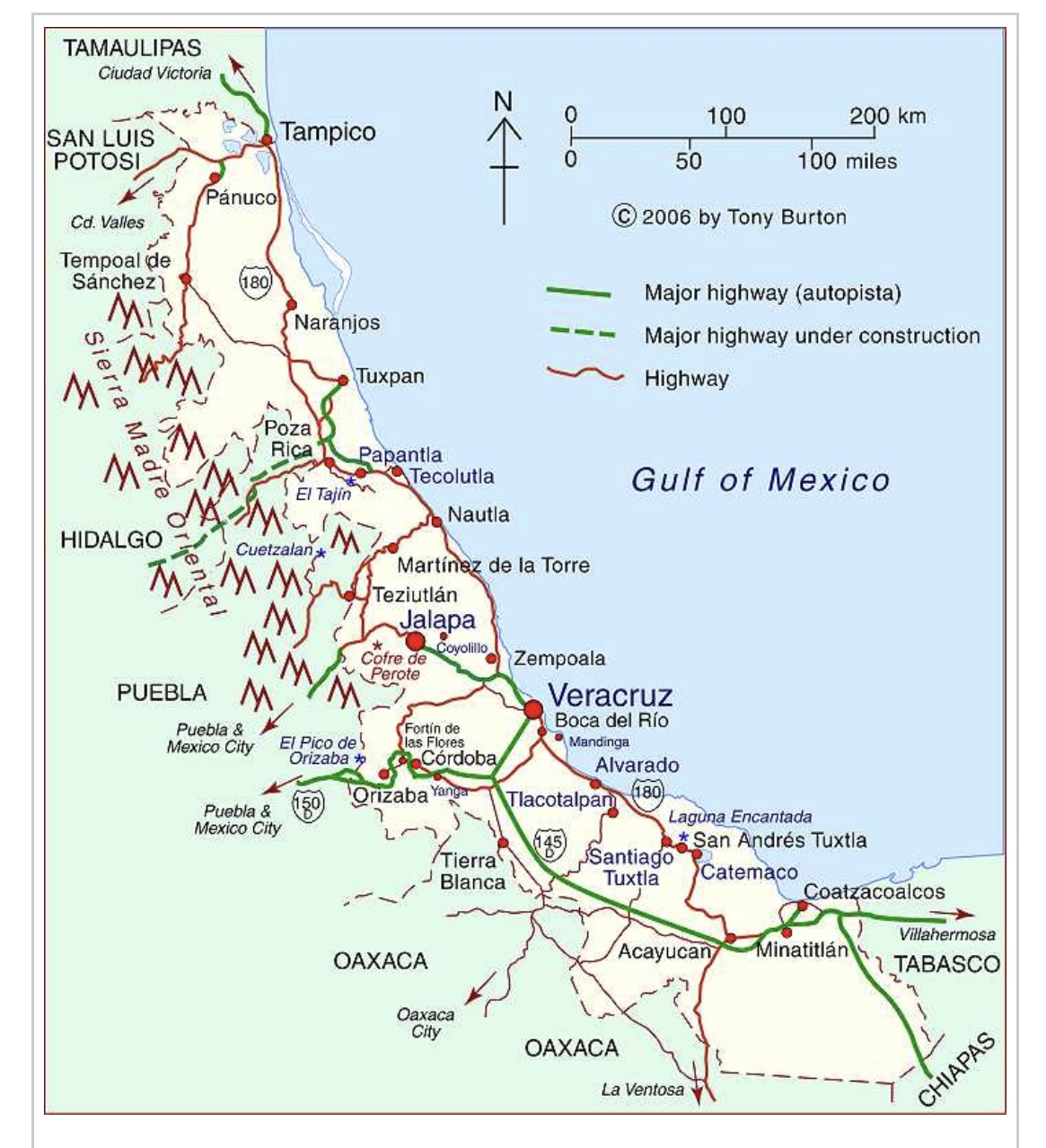
The state of Veracruz

As a destination, the state of Veracruz is overlooked by most travelers. There are better beaches and colonial architecture elsewhere. But for those who have explored other parts of the country, and are looking for something different, discoveries are waiting to be made. Unlike in resort areas such as Cancun, or colonial towns such as San Miguel de Allende, your travel companions are likely to be Mexican families and couples on weekend getaways rather than American travelers.

You won't find much English spoken. You will enjoy comfortable rides on first-class buses; a sense of safety due to lack of pick-pockets or hustlers; restaurant meals for around $25 for two; coffee drinks better than anything Starbucks can produce; and uncrowded museums.

Our first stop was Orizaba, a town of around 500,000 nestled in a valley surrounded by mountains in central Veracruz, four hours by first-class bus from Mexico City. 

Flat, one-story buildings painted in bright colors line narrow streets leading to the historical center. Our Airbnb was unusual in that it was a complete and modern apartment in a newish three-story building with a sushi restaurant the top floor. 

Next door was a mom-and-pop shop where the owners sold drinks and snacks though a slot in the door. I bought water there twice until I discovered we were around the corner from the local version of Costco filled with Mexicans pushing huge carts filled with diapers and soda. 

Veracruz State Art Museum

Our go-to morning stop for coffee and chilaquiles was the modern Cafe-Cafe Bistro with a QR code menu and tables an outdoor courtyard. Down the street was the Veracruz State Art Museum housed in a 16th century former monastery, hospital and women's prison. 

Mexicans come to Orizaba on weekends to stroll though an open-air animal reserve along a six-mile walkway skirting the Orizaba River. Bridges link paved paths on both sides, making it easy to get up-close views of jaguars, monkeys, llamas and lions.


Orizaba riverwalk and zoo

Near the riverwalk is the Orizaba's other main attraction, the Teleferico or cable-car transporting visitors to the top of a mountain with forested walking paths, and views of Pico de Orizaba, a snow-capped volcano that is the third -highest mountain in North America. Long lines form on weekends, but when we visited on a Monday, there was no wait.

Gustave Eiffel's Iron Palace

Relaxing at a cafe is a popular pastime everywhere in the state of Veracruz, a major coffee producer. We sampled the local speciality, the Picardía Orizabeña, prepared with coffee liquor, condensed milk and espresso, while people-watching on the terrace of the Gran Cafe de Orizaba attached to the Palacio de Hierro or Iron Palace. Designed by Gustave Eiffel (architect of the Eiffel Tower in Paris), the art nouveau city hall was built from metal and wrought iron imported from Belgium in the 19th century when Orizaba was the state capital. Today the building houses several museums including a beer museum which dispenses free beer courtesy of Heineken International, owner of brewing plants in Mexico including one in Orizaba.

Xalapa/Coatepec

Four hours by bus from Orizaba is Xalapa, the current capital of the state of Veracruz, and the jumping off point for a visit to Coatepec (Hill of Snakes) and Xico, two Pueblo Magico towns in a premier coffee-producing region.

Rompope frappé

Quaint hotels, parks and shops line the streets of Coatepec, a short taxi ride from Xalapa. Organized tours cover visits to a coffee museum a few miles out of town but a better plan on a hot day is to cafe-hop about town, sampling cold concoctions. Among our favorites was a frappé (espresso, milk, crushed ice) spiked with Rompope, a Mexican eggnog-flavored liquor. 


Downtown Xalapa


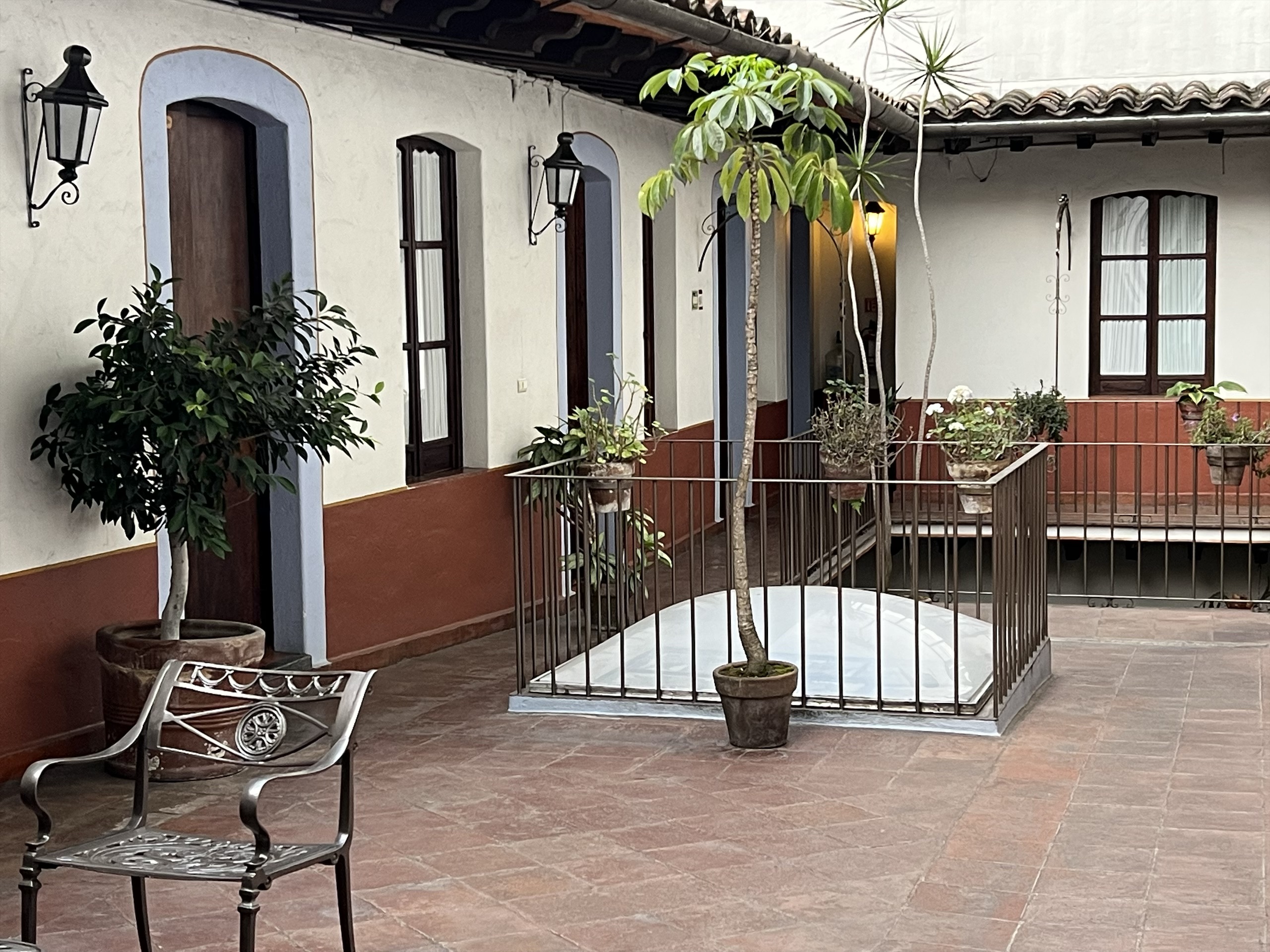
With a population of 800,000, Xalapa is a hectic university and government town, probably not the best choice for those with a car, but we found it a convenient base for exploring by cheap taxis. Our hotel, the Meson del Alferez Xalapa, was a former colonial mansion in a residential neighborhood until the town built up around it. Now it fronts on one of Xalapa's busiest streets where police use ear-splitting whistles to control traffic. Surprisingly, its rooms were quiet, protected by thick outside walls and an interior courtyard.


Courtyard rooms at Meson del Alferez in Xalapa


A cook makes tortillas at the Meson del Alferez

Sometimes spelled Jalapa, the city gave its name to the jalapeño chili pepper grown in the surrounding area. Built on hillsides, Xalapa is set up in a way that almost everything worth doing requires a walk up or down steep streets. Parque Juárez is Xalapa's main square. Ringed with snack kiosks and shoe-shine stands, it doubles as the town's terrace with views of the valley below. 

An Olmec colossal head dating from 900 BC 

At the Museo de Antropologia de Xalapa, the focus is on the main pre-Hispanic civilizations from the Gulf coast, with well-preserved artifacts displayed in galleries that descend the side of a lush hill. Noting that the museum was just two miles from downtown, we decided to walk. It took us an hour and half to wend through various neighborhoods to avoid hills and busy streets - well worth the effort, but once was enough. We took a $2.50 taxi back.


Preparing a lechero

Locals love their morning lecheros, Mexico's most popular coffee drink similar to what we call a latte. Many cafes serve it, but we waited until we reached the city of Veracruz to sample it at the Gran Café de la Parroquia, a 215-year-old cafe near the waterfront. 

With 40 mile-per-hour winds scrapping our plans for a walk, we took cover inside, and watched the ritual unfold. A waiter brings glasses filled a quarter of the way up with espresso. Then, with a tap of a spoon on the side of the glass, he signals the "milkman," another waiter who comes by with a kettle of hot milk. By pouring a stream high and slow, he creates a thick layer of foam on top.

 "Going to Veracruz and not going to the Café de la Parroquia is like not having been to Veracruz," someone said. 

Perhaps it was the Covid pandemic's effect on local businesses, but we couldn't find many reasons to spend much time in Veracruz. As attractions go, La Parroquia topped the list. 


Safe travels: The U.S. State Department assigns various levels of caution for traveling in Mexico, depending on the state. It advises against travel in six states, including the state of Tamaulipas where four Americans were recently kidnapped and two killed. It recommends reconsidering travel to seven other states. Veracruz is one of 17 states where the department recommends exercising caution.


Jan 28, 2020

Micro loans fuel dreams of female entrepreneurs in Oaxaca, Mexico


Oaxacan weaver Guillermina Carreno Gutierrez, 85

It's Thanksgiving Day, 2019, and while most Americans are sitting town to turkey dinners, a dozen visitors to the city of Oaxaca in Southwestern Mexico are piling into a van for the 45-minute ride to the Zapotec village of Teotitlán del Valle. There awaits a lunch of tortillas filled with black beans, cheese and chicken; bowls of a fragrant green vegetable soup and chilled glasses of tamarind water.

We've happily traded away a holiday traditionally spent with family and friends to join a "microfinance tour" of rural villages sponsored by Foundation En Via. The non-profit funnels  the $50 each us paid for the meal and transportation into interest-free loans for self-employed female entrepreneurs. They weave rugs, raise sheep and make tortillas in rural communities where houses made of mud bricks and dirt roads contrast with the stylish cafes, hotels and boutiques in Oaxaca's tourist hub.

Microfinance lending is common in many underdeveloped parts of the world. What sets En Via's programs apart is that all the borrowers are women, based on the principal that women are the ones most likely to invest in their families and their communities.


“It’s not necessarily about fighting poverty as much as its about empowerment," En Via staffer Kendall Hitch told us. “Women (in these villages) historically have had very, very limited access to financial institutions."

En Via, started in 2010 by an Oaxacan and an American, changes up the game by lending to women in groups of three, using a "solidarity model" that requires women to support each other it comes to following through on required classes, goals and loan repayments. 

Borrowers must complete money and business management classes before receiving their first loan. As they move through the process they attend monthly classes on developing a small business, and finally present their businesses to a group of responsible tourists. That's where we come in.

En Via funds around 80 percent of its loans from the tours it offers, with another 20 percent coming from donations. The aim of its tours is to show travelers a different side of Mexico, while giving the women experience in presenting their products and business plans as they were pitching to bankers or investors.


Maria Sosa Luis and her daughter, Marcela,
cook tortillas on an outdoor comal

Our first stop is at the home of Maria Sosa Luis where she and her daughter, Marcela, have set up the large, communal table in front of an alter adorned with religious statues and pictures. She and Marcela cook tortillas on an outdoor grill while we start with a soup made with fresh greens, squash and herbs. Next to the cooking area are two sewing machines. Hanging nearby are beautiful woven rugs and jewelry, most with price tags, a tip they picked up in an En Via training class. Maria's goal (everyone in the program has one) is to start a small restaurant outside her home.

Loans start small, and can grow. The first - 1,500 pesos or the equivalent of $80 U.S. dollars   - must be paid back in 10-15 weeks. Subsequent loans can go as high as 7,000 pesos ($375). Only one in 100 defaults.


Maria Lazo Bautista grinding cochineal

Our next stop is the house of Maria Lazo Bautista who explains that as a child, she helped her mother wash wool, and began weaving when she was 15. She uses natural dyes made from plants, seeds and insects, demonstrating how she produces a bright red dye by pulverizinng dried cochineal, bugs that attach themselves to the pads of prickly pear cacti, then adding lime and salt to produce different shades. For now, she sells her textiles out of her home, but her goal is to open a shop. 


Yarn colored with natural dyes
Next door we meet another weaver. Adelaida Ruiz Carreno and her mother, Guillermina Carreno Gutierrez, 85. Skanes of colored yarn hang from a hook over looms in a mud brick work area. Adelaida, on her second En Via loan, says the training classes taught her how to calculate a profit and how to invest in her business to make it grow. She sells out of her home and at the village market on Sundays, but knows that if she had a shop with regular hours, she could sell more and more often.  As we're leaving, she goes to a tree to pick the pomegranates, (she uses the seeds for dyes) and gives us a few to take with us.


Adelaida Ruiz Carreno
We end the day at the home and farm of Isabel Lopez Mendez in San Sebastián Abasolo, an agricultural village where horse carts bump along the dirt streets. Isabel grows oats, garlic, runs a tortilla business in her garage and raises sheep. Before En Via, she had a bank loan, but it carried a 30 percent interest rate. 


A smiling Isabel Lopez Mendez

"The En Via loan is small, but I have more money now, and don’t have to think about paying back the interest. It helps," she tells us. She wants to use her next loan to buy a bull. In the meantime, she's learned how to make a savings plan, and recently took a class in customer service. There, she says, she learned the importance of smiling and engaging the people who come to buy her sheep.

Jan 4, 2020

Up Close and Personal in Mexico City


Global Greeter Oskar Sandoval

MEXICO CITY - Leaving our hotel on a busy Monday holiday, my husband, Tom and I, walk a few blocks to a museum where we look for a statue of a Spanish king on a horse. It's here where we are to meet Oskar Sandoval,  22, a volunteer with Mexico City Greeters.

We spend the next five hours together, walking, chatting about everything from immigration to homelessness, sampling ice cream, and marveling at the art deco architecture in a 19th century neighborhood of Tabacalera, named for a cigarette factory that now houses an art museum. 

Fast-forward to dinner later that evening. An Uber driver drops us off at the home of Roberto Escoto and Cristina Unna. They are members of eatwith.com, a website that follows the Airbnb model of connecting travelers with locals worldwide - not with a room but with a shared meal in their home.


Gathered for an eatwith dinner with Cristina, Luz and Roberto

We're together for the next three hours as we eat and talk about life in the United States and Mexico. The next morning, we become Facebook friends.

It would be easy to feel lost in a city the size of Mexico City. With more than 20 million people, the metropolitan area vies only with Sao Paulo, Brazil as the most populous in Latin America. You arrive as a stranger, but with a few well-planned local connections, you don't have to feel like one. 

Three suggestions for an up close and personal visit:   

Sign up with a Global Greeter

We found Oskar through the Global Greeters Network, an organization with volunteers in more than 200 destinations worldwide. The greeters aren't tour guides, and don't accept tips. Rather they focus on special places that have a personal meaning to them, often hidden treasures away from the usual tourist sites.

Oskar and I began e-mailing and texting on WhatsApp a week before we left Seattle.
When he mentioned that two of Mexico City's largest newspapers were headquartered in Tabacalera, and that an old-time ice cream shop still made tobacco-flavored ice cream, I was all in.

Oskar studied English in Vancouver, B.C., and earned his degree in history from a public university where tuition is free for those who qualify. In between his volunteer gig with Mexico City Greeters, he does research at a botanical gardens as part the mandatory public service the university requires of graduates.


Revolution monument in Tabacalera


Former cigarette factory, now an art museum

We walked by the newspaper offices, the old tobacco factory, and the Monument to the Revolution, an arched observation tower built around the remains of a palace planned for Porfirio Díaz, Mexico's president for 30 years until he was deposed.  


Oskar and me with tobacco-flavored ice cream

Over a dish of the tobacco-flavored ice cream (surprisingly tasty with maple syrup and strawberries) at La Especial de Paris, in business since 1921, Oskar explained his reason for volunteering his as a greeter.

"When people ask me if Mexico is a dangerous country, I say 'yes it is,' but it's not all of the country. Mexico City is one of the safest places to be. I want people to feel like they can walk around the city without any problems." 

Eat with a local

We've shared dinner and conversation with home cooks in France, Italy and Spain through the meal-sharing website eatwith.com. So I was delighted to come across good reviews for the "Celebrating Mexico" four-course dinner Roberto Escoto and Cristina Unna offer in their home, about a 40-minute Uber ride from the historical center.

With the fee arranged through Eatwith in advance ($48 per person), we felt more like friends invited over for the evening rather than paying guests. 

The couple welcomed us into a cozy living room filled with art, antiques and shelves lined with record albums, CDs and books. 

Roberto, 62, works in recycling and Cristina, 60, runs a cultural center. Both are devoted amateur cooks known to throw Paella dinners for 50, and stage pop-up dinners in Chicago when visiting their daughter.


Robert Escoto

Roberto mixed Margaritas as we chatted with Cristina and their friend Luz, visiting from Cuernavaca. After some get-to-know-you conversation, Cristina and Roberto went to the kitchen, put on aprons and reappeared a few minutes later with platters of quesadillas stuffed with zucchini flowers and mini tortillas filled with refried beans topped with pork and  salsa. 


Cristina Unna serves her tomatillo soup

Dinner began with a soup made from green tomatillos, followed by Chiles en Nogada, CQ a Mexican national dish featuring a Poblano pepper filled with minced pork and a mix of fruit and spices covered with a creamy walnut sauce.

In her spare time, Cristina makes fruitcakes - 100 every year which she sells around the holidays. We toasted our new friendship by sharing the first slices of the season. 
When it came time for us to go, she wrapped up a few pieces us to take home, along with a bag of her homemade granola.  

Sleep mindfully 

Many Americans head to hotels in the Zona Rosa, an area known for its shopping and nightlife. Scruffier but more authentically Mexican is the Centro Historico, a 34-block area, home to some of the city's most elaborate historic monuments, former palaces, traditional restaurants and museums. 

A few years ago, I might not have considered staying in Centro, but things have changed, thanks to young entrepreneurs such as David Marino.  He and his mother, Rosalie, own  Chillout Flats, an urban bed and breakfast in a residential building surrounded by bakeries, cafes and chic restaurants.


David Marino talks with guests at Chillout Flats

Over a breakfast of watermelon juice, fresh fruit and eggs, we met guests from Peru, France and other parts of Mexico. David and Rosalie shared tips for getting around, and pointed out their favorite spots for a meal.

Just around the corner was the 1912 Cafe de Tacuba where mariachis serenade diners enjoying traditional dishes in a dining room decorated with colorful tiles, stained glass and murals.Down the street was Rosalie's favorite, the Cafe La Pagoda where locals line up for bargain breakfasts such as the $3 plates of huevos divorciados -  eggs "separated" by their salsas, one a fiery red, the other a jealous green.  


If you go:

Transportation/Communication: 

Apart from the metro system, Uber is the best way to get around the city. Fares are inexpensive, but vary with the time of day. Most locals use WhatsApp to communicate via text message. 

Making connections: 

*Book a lunch or dinner through eatwith.com Enter your destination, the dates you are available and the number of people in your party. Select from regularly-scheduled meals, or click on "show experiences available on request." This is how we found our hosts, Cristina and Roberto. Most reservations can be cancelled within 24-48 hours at no charge. Payment is made online through eatwith.com.

*Arrange for a volunteer greeter through the Global Greeter Network or Mexico City Greeters Greeters don't accept tips, but it's nice to offer to pay for coffee, lunch or a drink. The organization accepts donations through its website. 

*Sleep in a bed and breakfast, or an Airbnb, provided it's a room in someone's actual home as opposed to a commercial apartment. The family-run Chillout Flats, is an eight-room bed and breakfast run by David Marino and his mother, Rosalie, on the upper floors of a classic building in the historical center. We paid $65 per night for a large suite, with private bathroom and breakfast.  

*Ask your friends if they know anyone studying or working in Mexico City.  We had dinner our first night with an American friend of a friend who teaches English. He and his Mexican girlfriend met us for dinner, and introduced us to what became our favorite drink - pulque - made from the fermented sap of the Agave plant.

This story appeared in The Seattle Times on January 19, 2020