Showing posts with label COVID-19. Show all posts

Nov 5, 2022

Postcards from Paris: Post-pandemic musings from my favorite city


Cafe de la Rotonde on Boulevard Montparnasse

Warm lights inside the Art-Deco-style Cafe de la Rotonde beckon early risers for a quiet coffee. Lines no longer snake outside museum entrances. Late afternoons call for a wooly scarf and an Aperal spritz on an outdoor terrace. 

With the summer crowds gone, Paris is Paris again. It may just be my favorite city, especially in late fall. I've been coming here almost every year for the past 20. Now, after a two-year break due to Covid, I'm feeling my way around again. 

My favorite two-star hotel near Place de la Nation has raised its prices, and installed AC in all the rooms. 

The husband-and-wife owned tea salon next door appears to have permanently taken over a wide swath of sidewalk with its its Covid-era outdoor seating. No heaters though. Paris is on an energy-saving diet. 

My paper Metro tickets left over from my last trip still work, but not for long. The carnet - a booklet of 10 tickets sold at a discount - has gone digital with a pre-loaded plastic Navigo card. 

What's changed? What hasn't? What's new, given preparation for the summer Olympics in 2024? 

 A few musings after a week's stay:

Transportation

Paris' metro, bus, RER and train systems remain fast and efficient most times; crowded and unreliable other times. Pre-Olympic improvements on the RER B and C lines make using either to get to Charles de Gaulle airport (RER B) or Orly (RER C) risky. Then again, buses and taxies get stuck in traffic. And with new construction and renovations underway everywhere, traffic is bad.

After waiting 40 minutes one morning for a bus to De Gaulle that never came, I ran across the street to the RER station, and with one metro connection, made it to the airport in 40 minutes. Another morning, the RER B was out of service several stops before De Gaulle, requiring a 20 minute ride the rest of the way on a shuttle bus. Another day it was shut down all together after someone left an unattended bag on the train. 

Best advice: Have a back-up plan, or better yet, spend the night before your departing flight at an airport hotel. The Ibis CDG Airport hotel a few steps from Terminal 3 is one of the best options. It's clean, modern, reasonably priced, and the only way you could miss your flight is if you sleep in.

Be prepared for many people commuting to work and school on bikes and scooters. Step into a dedicated bike lane with the same caution you would crossing a street. 

Inflation and the U.S. dollar

Inflation has hit Europe hard, and Parisians will tell you they feel the impact of rising prices. Cushioning the effects for American travelers is the rising value of the U.S. dollar, now worth slightly more than the euro. 

A 5 euro coffee at the Rotonde is $4.95 U.S. whereas in 2021, it would been around $5.90. This means it costs less to relax here in elegant surroundings, sipping coffee served with a pitcher of warm milk, than it does for a pumpkin spice latte at Starbucks.

Good value has always been easy to find in Paris, and still is. Look no further than a neighborhood away from the major sites.

Example: My 12 euro ($11.64) lunch of smoked salmon, salad, bread and  an anise Pastis at La Fee Verte, the Green Fairy, a classic cafe near Pere- Lachaise cemetery. The cafe  specializes in absinthe, the green anise-flavored spirit favored by Parisian artists and writers in the late 19th and early 20th centuries. 

The Green Fairy cafe

I found it by walking along the Rue de la Roquette towards the Bastille, a route suggested by Harriet Welty Rochefort, a Parisian ex-pat author (French Toast and French Fried among other books) and friend whom I had met for coffee earlier in the day.

Harriet and I at a cafe near Pere-Lachaise

In the past the La Roquette district was known for containing two prisons: the "Petite Roquette" for young delinquents and women, and the "Grande Roquette" for major criminals. The guillotine was brought out at night to bring the lives of the imprisoned to a fateful end.Today, the district is a happier place filled with trendy art galleries, bars, restaurants and a busy nightlife.

Self-service everything

The same "staffing" shortages affecting U.S. retailers are affecting most service providers in Paris. Expect to use a self-service kiosk to buy everything from grocery items to train and metro tickets. 

I spotted only one or two live cashiers in many stores, including the gourmet section of the luxury Galeries LaFayette department store which draws many foreign tourists.


Galeries Lafayette

Passengers obtaining boarding passes from Air France at Charles de Gaulle must use self-service kiosks as well as check their own bags. 

Apple Pay is accepted almost everywhere as well as credit cards equipped with the "tap" symbol for contactless payment. To take advantage of the most favorable exchange rate, avoid withdrawing euros from Euronet Worldwide bank machines installed near many shops and restaurants. They charge a hefty fee -$3.95 euros - plus surcharge - 12 percent or more - by lowing the exchange rate below what is available from ATMs operated by real banks. The exchange rate might be 0.82 euros to one dollar, for instance, compared to the current rate of 0.99.

A clue will be instructions to tap on "accept this exchange rate" before you complete the transaction.

Duty-free shops at De Gaulle airport offer customers the option of paying in euros or dollars. Always opt for euros to avoid similar surcharages.

Iconic sites and off-the radar art

No matter if you're a first-time or repeat visitor, everyone feels the pull to walk past and/or visit the iconic sites for which Paris is known. 
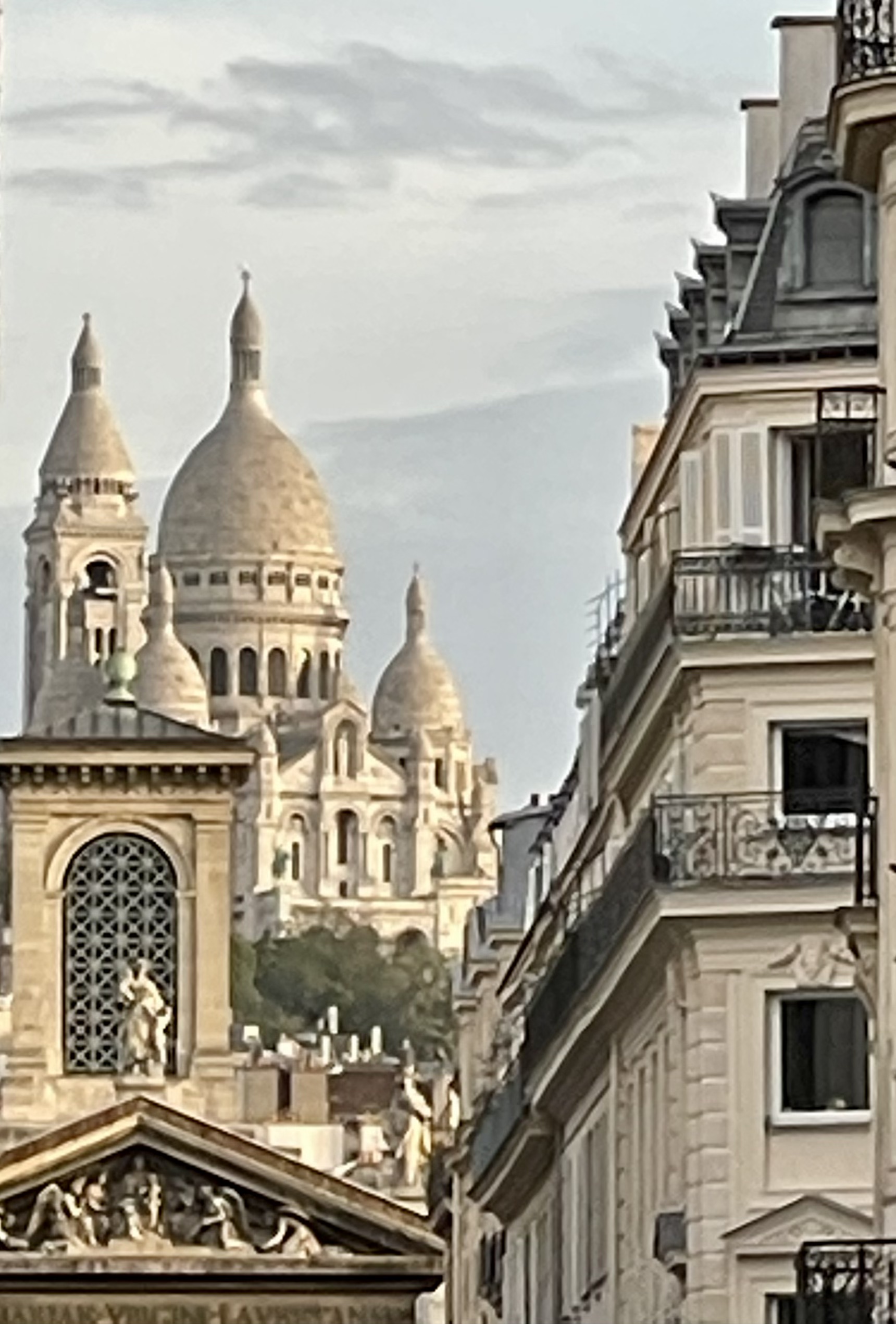
Sacre-Coeur in Montmartre

I like to find vantage points in unexpected locations. This sighting of Sacre-Coeur high on the hill in Montmartre came into view as I glanced down a side street while walking towards the Galleries Lafayette department store.

Notre- Dame Cathedral

Notre-Dame Cathedral is scheduled to reopen to the public by 2024—five years after a fire collapsed its roof and toppled its spire. It looks much the same from the front, minus the spire, but the entire back area is a construction site.

Visits to major museums require advance purchase of timed tickets.The show-of-the-moment is Frida Kahlo at the Palais Galliera, usually sold-out each day. On the other hand, it was easy to walk right into the Musee d'Orsay with a time ticket purchased the day before.  Sadly, one of my favorite paintings was missing. 

Degas's Absinthe Drinker

I looked everywhere for Edgar Degas's Absinthe Drinker. Finally, I asked, and was told it was on loan to the Louvre Abu Dhabi. The 1886 painting portrays a woman and a man sitting in a café, staring blankly, looking almost sad. The painting became controversial after it was discovered the artist used models posing as real patrons, and painted it in his studio, not a cafe. The painting cast a slur on the reputations of the two models, and Degas had to state publicly that they were not alcoholics.

Not everyone has time for Paris' lessor-known museums, but making time for at least one can feel more rewarding than trudging though the big sites. 

Burdens literally fall on the shoulders of women all over the world as depicted in a moving exhibit by American/Indian photogrher Lekha SIngh at the Musee de l’Homme (Museum of Manknd). Fifty portraits celebrate the courage and strength of women in India, Tanzania, Morocco, Rwanda, Kenya and other countries. They are the non-motorized engines that transport heavy loads everyday to provide fuel, water and building materials for their families.

A woman from Kenya carries a stone to build a fire pit for her family


Women in Tanzania fill 50-pound pots with water to carry to their families

The bonus of visiting this museum (Trocadero metro stop) is the dead-on view of the Eiffel Tower from the upstairs cafe window. 

Paris greeter Raphael Rispoli

Better than any museum is to spend a few hours with a Paris Greeter. These are locals who volunteer to spend time with visitors on two to three-hour walks around the city. They are not tour guides, but rather people who enjoy meeting others and sharing their knowledge of  favorite areas.

 I met up with Raphael Rispoli for a two-hour morning walk around the Left Bank, starting near the Jardin du Luxembourg and ending at the River Seine near Notre Dame. We enjoyed lunch together afterwards at a small restaurant before parting ways in the early afternoon.  


Oct 9, 2022

‘It’s forbidden, but you can do it,’ in Porto, Portugal’s relaxed second city


A vintage tram runs along the Porto riverfront to the ocean beaches


You go girls: The Tuna Feminina outside the Sao Bento train station in Porto

Serendipitous sightings, such as this all-female group of street musicians, always seem to trump the traditional must-see sights in any city. Porto, Portugal’s second-largest city after Lisbon, is no exception.

It wasn’t that long ago that this northern coastal (Oporto in Portuguese) city, 30 minutes from the Atlantic Ocean, was known mainly as a transportation hub for Port wine coming from grapes grown in the nearby Douro River Valley. Tourists  began discovering its hilly cobblestone streets, Art Deco architecture, cafes, restaurants and medieval city center after Ryan Air began offering cheap flights a few years ago. 

The Medieval Porto waterfront

Today, Porto is firmly on the bus tour circuit, but for those who can make it more than a day trip from Lisbon, rewards await.

The view from the balcony of our Airbnb on pedestrianized Rua das Flores

Tom and I flew here directly from Amsterdam, the first stop on a trip aimed at discovering a few new “second tier” cities away from the major urban hubs attracting post-Covid crowds. We loved people-watching from the balcony of our Airbnb on Rua das Flores, one of many pedestrian shopping streets in the historical center. Our hostess thoughtfully left us two little bottles of port to christen our arrival.

When in Porto…

Student choral groups regularly gather here and elsewhere performing traditional Portuguese folk songs. They dress in black, and are mostly male. It was good to see young women getting into the act, strumming mandolins, base fiddles, accordions etc., and opening their guitar cases for tips. We found the group, performing above, while on our way into the Sao Bento train station, a century-old former convent known for its 22,000 ceramic blue tiles depicting important historical events. The station is pretty, but our real “find” that day was this enthusiastic group of female musicians.

Sao Bento train station 

Our Airbnb didn’t come with breakfast, which was fine because it gave us a chance to try out some Portuguese morning specialities such as the pastel de nata - little egg tarts; the galao, a latte served in a tall glass; and sardine sandwiches with roasted red peppers. Everyone speaks English and Spanish here, but it’s been fun perfecting the three Portuguese words needed to order the egg tarts and coffee.

Favorite 5 euro mid-morning snack

For anyone in search of Americanized breakfast fare, there is the museum-quality MacDonald’s in the location a former 1930s Art Deco cafe. All the mirrors, chandeliers and stained glass remain intact.


“It’s forbidden but you can do it,” is Porto’s motto, according to Sergio, a tour guide for Porter Walkers which leads groups on daily, free two-hour walking tours. This might apply to walking up to the city center from the riverfront instead of taking the funicular or a cab. Or breaking your diet to join the locals in their favorite lunchtime pastime of indulging on a sandwich called the Francesinha or “Little Frenchie.”

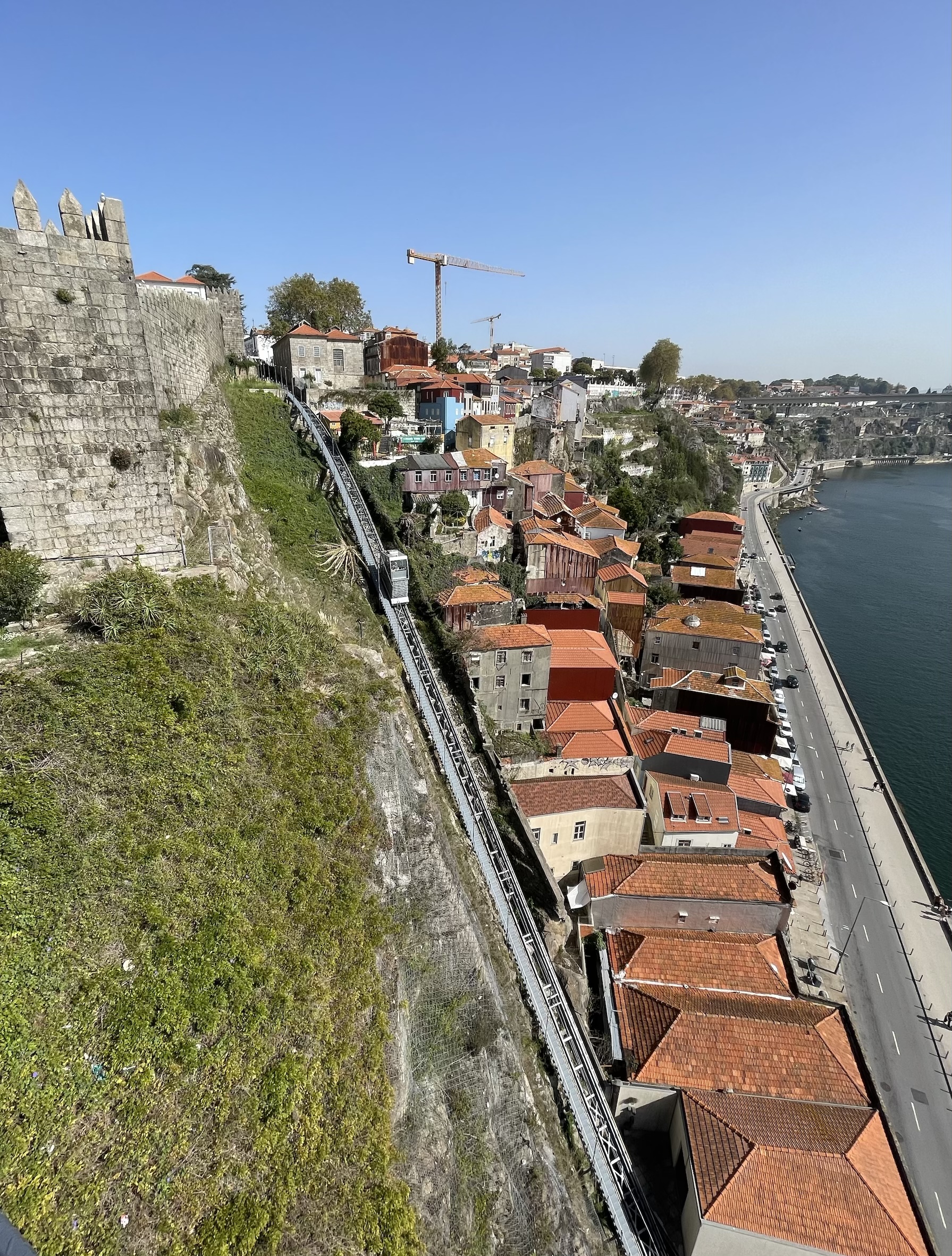
The Porto waterfront along the Douro River. 

The funicular from the waterfront to the top of town looked like a Covid breeding ground, so we climbed the stairs instead. 


Tom felt the walk justified a Francesinha, a heart attack on a plate that our guide, Sergio, says he allows himself to eat just once a month. The sandwich consists of five types of meats and cheese sandwiched between slices of white bread, topped with sauce and an egg. We shared ours at a sidewalk table at Santiago’s, the go-to place in town for the best Francesinhas. Our waiter was pleased that Tom joined his clean plate club. As any good journalist knows, “Anything for the story (or the picture),” as long as it’s legal and doesn’t harm anyone, not counting yourself.

 A Francesinha at Santiago’s in Porto


Portuguese food on the whole seems heavy on meat, so we’ve been sticking to its other speciality, cod fish, or trying out a surprising variety of ethnic restaurants. Our favorite so far was a Nepalese restaurant where we had a vegetarian meal of momos (dumplings), cauliflower pakora; and a platter of tofu curry and veggies. Portugal is good value, especially with the euro and dollar now equal in value. Dinners for two have been running us around $35. 
One of Porto’s best museums is the Serralves contemporary art museum and sculpture park, a 5 euro Uber ride from the city center. Set in wooded areas and gardens are pieces by Clases Oldenburg (creator of the Typewriter Eraser  that the Seattle Art Museum displayed for a while), and Anish Kapoor, whose Sky Mirror produced an interesting selfie.

Clases Oldenburg’s Plantoir 

Selfie in the Sky Mirror


The garden tasting room at Taylor’s in Porto

All the famous English port wine producers (Taylor’s, Dow, Sandeman) have operations based in Vila Nova de Gaia, across the river from Porto, and in the nearby Douro River Valley where a microclimate is ideal for cultivating olives and almonds as well as grapes. Port developed in the 1700s when war prevented the British from continuing to import French wine. Looking for a substitute, they discovered Portuguese wine. Port, fermented and fortified with alcohol, became known as a wine that could survive a long sea journey. We visited Taylor’s cellars and tasting room in Porto, then headed two hours by train to the small town of Pinhao in the Douro to see the terraced vineyards in the mountains.

Vineyard views from a mountain top village


Vineyard views from a river boat 

One way to take in the landscape is on a one-hour boat cruise. The other is to take a taxi to one of the high-up villages such as Casal de Loivos, altitude 1,400 feet, and walk back to Pinghao, a 2.5-hour zig-zag trek through olive groves and vineyards. We tried both, reaching the mountaintop village by taxi with a friendly female driver, and doing an olive oil and wine tasting in town before walking down.

Olive oil and wine tasting at Casal de Lovios  


The walk downhill through the vineyards

The walk was filled with amazing views. We look happy here, but with temps in the low-80s, full sun and no shade, we were also happy when we reached the bottom an hour and a half later. A restaurant called the Writer’s Place called our name. Located next to the train tracks, it was originally one of several small houses set aside for railroad employees.  One of them was a writer. The owner greeted us as we walked by, and showed us a table overlooking the river. How could we resist? His wife cooked a traditional Portuguese meal - green soup made with kale and potatoes, baked cod and roasted peppers.

The Writer’s Place in Pinhao


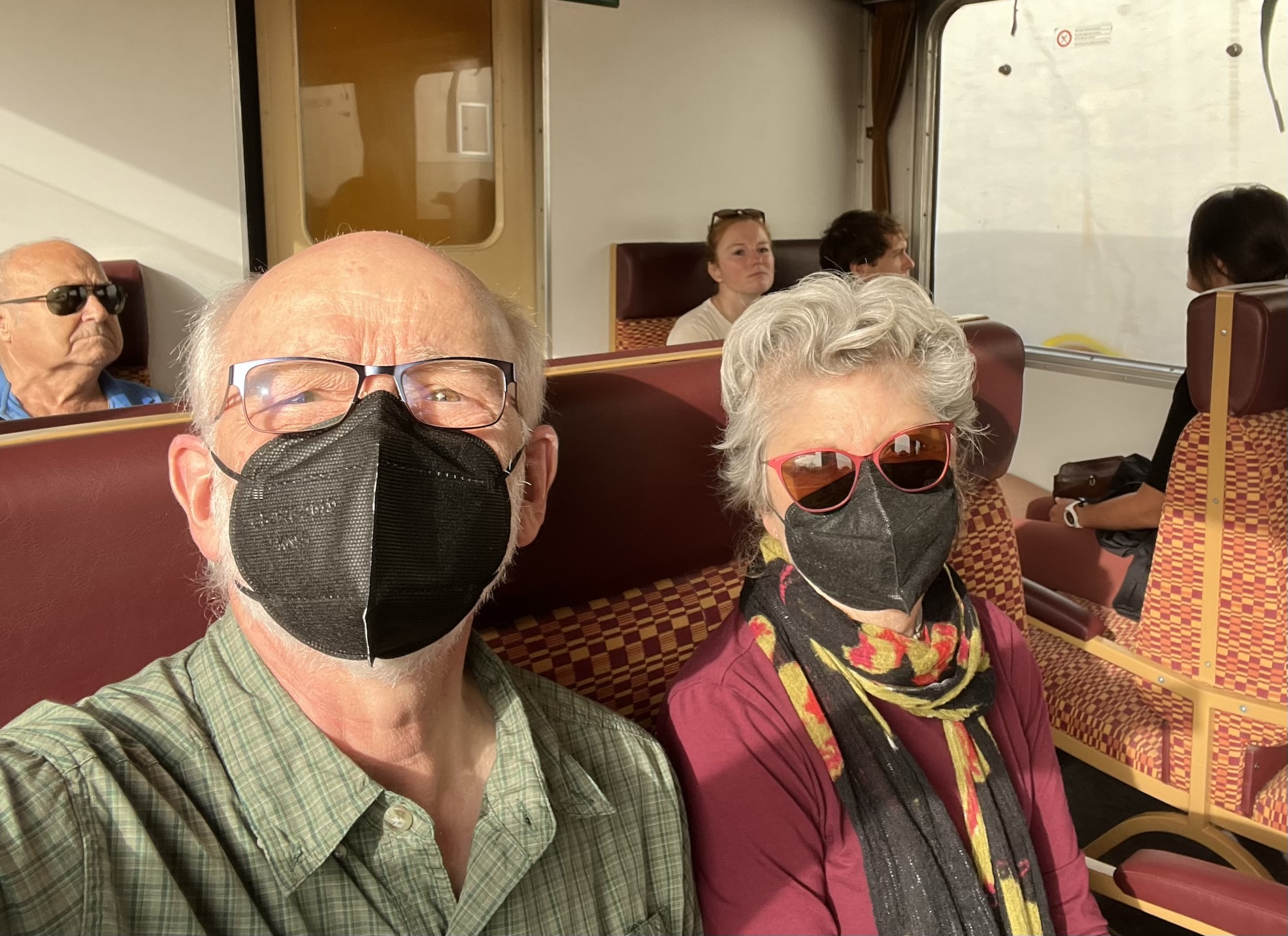
P.S. We are the only ones wearing masks on the trains, trams or indoor public places. Covid cases are rising in many parts of Europe. Many people we know have tested positive for Covid during or after traveling, so we’re not taking any chances. Strongly suggest you do the same if there’s a trip in your future.


Tom has done a terrific and more detailed report on our trip with all of our pictures at https://puciello.com/wp/1-hello-from-porto-portugal/


Sep 29, 2022

Porto, Bilbao and other stops along the way to post-pandemic overseas travel


Despite nagging uncertainties about Covid, tales of crowded airports, lost bags and high prices, strategic planning may be all the travel insurance you need for successful overseas travel this fall. 

That's what I'm finding as Tom and I put finishing touches on our second European post-pandemic trip this year, this time to Porto in Portugal; Bilbao in Spain; a few days with friends at their rental house in southeastern France; and some time in Paris.

This is what I call  "tame" travel, nothing complicated and no third-world destinations. That saddens me a little since our last trips before Covid were to Egypt, Uzbekistan and Myanmar. There will come a time for more adventuresome travel again, but Covid is still with us no matter how hard we'd like to wish it away. So for now, we're sticking to areas that carry fewer risks, making no non-refundable upfront payments, and honing in on new cities and experiences while avoiding crowds and crowded airports.

The plan starts with what's called "second tier" cities - large cities that don't include the busy capitals.

Port in Porto

We've been to Portugal only once, and to Spain a few times, but never to Porto, the transportation hub of the wine trade for which port wine got its name. Harry Potter author J.K. Rowling lived here between 1991 and 1993, inspired by visits to the Lello bookstore and Majestic CafeAlso new to us is Bilbao, the urban, riverside hub of Basque country, a culturally unique area between southern France and Spain. 

When it comes to avoiding the hassles of major airports and tourist crowds, flying directly into  a smaller city is always a good move. Many are surprised to find that this is fairly easy to do from the U.S., given the availability of non-stops to European hubs such as Amsterdam, with onward connections to cities such as Florence in Italy instead of Rome or Milan, or in our cases, Porto instead of Lisbon.

No need for travel insurance to cover the airfare because it can be cancelled or changed without penalty, a policy most airlines instituted during Covid, and so far have not walked back. 

Finding accommodations with liberal cancellation policies has also been easy.

Since Covid, Airbnb has convinced most of its owners to offer fully refundable bookings within a few days of arrival. 

The pedestrian Rua das Flores

For our first three nights in Porto, we booked a lovely studio with a balcony overlooking Rua das Flores, a pedestrian street lined with 17-19th century buildings that once housed wealthy merchants. The price was a reasonable $125 per night, refundable up to five days ahead. 

The same policy applies to an $85-a-night Airbnb apartment we rented in Pinhao, the center of the port wine trade in the rural Douro River Valley, and  a six-room B&B ($110) back in Porto's Riberia historic district booked for our last three nights.

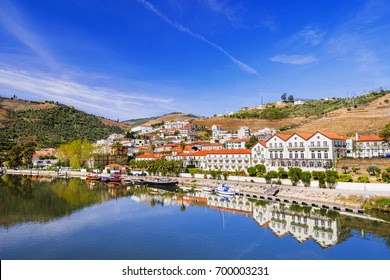
Pinhao in the Douro River Valley

Also changeable and refundable (for a credit) were our flights to Bilbao and Paris purchased online on Vueling Airlines, a low-cost Spanish airline.

With all the talk about inflation in Europe, American travelers may not find prices as high as expected, due to the strong dollar, now one-to-one with the euro.

The one place we did encounter sticker shock was in first-tier Paris where the price of the hotel room I booked in 2019 went up from $90 to $150. We could have looked harder, or just paid the price. But since we'd been thinking about taking a bike tour around Versailles, a wealthy suburb that King Louis X1V made the French capital from 1682 to 1789, we pivoted to a homey B&B there instead for $110 with breakfast. 

Putting together your own trip vs. taking an organized tour is more work, of course, but the rewards are independence and flexibility. Still, it's often easier to rely on someone else for short excursions that involve complicated transportation logistics or having a car. 

For these types of day trips I turn to "GetYourGuide," a Berlin-based online travel agency and marketplace for excursions offered by tour companies worldwide. There's no advance payment, and cancellations are generally allowed 24-48 hours before departure.


The Pavia Walkways near Porto

It's here I found a day trip from Porto by mini-van ($90 each) to the Paiva Walkways, a four-mile boardwalk zig-zagging through a geopark on the the left bank of Paiva river. It also includes a side trip to the   516 Arouca Bridge, a 1,692-foot metal suspension bridge suspended 576 feet above the water; lunch; and a boat ride along the canals of the nearby town of Averio. The tour company observes Covid precautions such as requiring passengers to wear masks, and takes half the usual number of people in its vans.


Gaztelugatxe Island

A similar excursion in Bilbao ($60 each) will take us to the island of Gaztelugatxe where a 10th-century hermitage is connected to the mainland by a bridge and 240 stairs. Some will recognize it as the island fortress of “Dragonstone” from season 7 of Game of Thrones.

Many Airbnb hosts offer activities such as bike trips and food tours. Filter for "experiences" to see what's offered in various cities. Eatwith.com offers opportunities to dine in the homes of locals. Sadly, we'll miss the chance for a traditional salt cod dinner in Porto because the Portuguese/Serbian hosts will be on vacation. 

Some independent travelers hire private guides, but for my money,  free group walking tours offered through websites such as Freetour.com and GuruWalk, are just as informative, and often more fun. The upbeat guides are often knowledgeable students or professors who work for tips. In Porto, we signed up for two free city walks offered by Porto Walkers which also offers paid port wine and food tours. 

in Bilbao, Freetour's 2.5-hour walk includes recommendations on where to sample the best traditional and modern “pintxos,” the Basque version of Spanish tapas.  Susana, a guide from GuruWalk who describes herself as someone with a "Greek passport and Basque heart," leads small groups through Bilbao la Vieja, a former industrial area which she calls the Soho of Bilbao.

We couldn't decide which of the walks to do, but the price was right, so we signed up for both. 


Jun 10, 2022

Testing requirement lifted for international flights, but at what cost to travelers' health and safety?


Pre-departure testing no longer required

Airline passengers traveling to the U.S. from abroad no longer have to produce a negative Covid test taken the day before travel. The move eliminates one of the hassles of flying internationally, but at what cost to the safety of customers and crew?

From the feedback I received on a recent blog post arguing in favor of keeping the requirement, many believe pre-departure testing is not worth the trouble or expense, even as highly-transmissible Omicron variants spread, and passengers no longer have to wear masks.

For those readers, the Biden Administration had good news over the weekend. As of Sunday, June 12, the Center for Disease Control and Prevention dropped its testing requirement which applied to all travelers entering the U.S. by air - vaccinated and unvaccinated. Airlines and others in the travel industry pushed the administration to drop the requirement, arguing it was hurting demand for international trips. 

Over the weekend, they praised the government's decision, citing mainly economic benefits, but not addressing how the move might affect the health and safety of passengers and crew. 

The administration put in place the testing requirement last year, as it moved away from restrictions that banned nonessential travel from several dozen countries. The initial mandate allowed those who were fully vaccinated to show proof of a negative test within three days of travel, while unvaccinated people had to present a test taken within one day of travel.

In November, as the Omicron variant swept the world, the administration toughened the requirement and required all travelers, regardless of vaccination status, to test within a day of travel to the US.

The CDC, which says it still recommends testing before any flight, said it will reassess the decision in 90 days.  “If there is a need to reinstate a pre-departure testing requirement — including due to a new, concerning variant — CDC will not hesitate to act,”  and official said.

Let's hope so, because in the meantime, anyone with Covid or with symptoms of Covid can now board an international flight to the U.S., no questions asked. There is no requirement that anyone wear a mask. Airlines argue that their filtration systems offer good protection, but that's not reassuring when someone sitting next to you for hours is coughing, or the plane sits on the tarmac for an hour waiting for a gate to open up (which happened to a friend recently in Newark and Seattle).  

Here's the situation one traveler found himself in when he recently boarded a flight from Los Angeles to Wyoming to see friends. 

"I sat rigid in my seat, and was aware of everything happening around me," he reported. "Simply put, I call it the C & S flight — Coughing and Sneezing. Everywhere. Every 4.3 minutes. Yes, I timed it."

Some argue that because the CDC never required pre-departure testing for domestic flights, it didn't make sense to require testing before boarding international flights. I'd counter that one bad decision doesn't justify another at a time the government is bracing for the pandemic’s "next wave" by asking for billions of dollars in Covid relief.

One prediction: Watch for airlines to equate the elimination of testing and masking requirements as a sign of downgraded risk. That could give them an opening to reinstate fees and penalties for cancelling or changing flights. The ability to change a flight, or cancel  and receive a credit has no doubt kept many sick people off planes. With Covid risks downplayed, how long will those policies stay in place? 


Jun 2, 2022

Airlines ignore passenger safety by lobbying to end pre-departure Covid testing for international travel


Testing "negativo" before a flight from Italy to the U.S.

At a time when highly-transmissible Covid variants are spreading even among the vaccinated and boosted, would you feel better about returning to the U.S. from overseas knowing that everyone aboard the aircraft had tested negative the day before, or having no idea who might or might not be infected with Covid. 

If airlines get their way, the U.S. could soon drop its requirement that all airline passengers - vaccinated or unvaccinated - produce a pre-departure negative antigen (rapid) Covid test the day before returning from an international destination. 

The U.S. Travel Association and Airlines for America, trade groups that represent the travel industry and U.S. airlines, are pressing the Biden Administration to end the protection, arguing that the "travel industry remains disproportionately harmed" by the requirement. Lifting the protective measure would "lead to more foreigners visiting the U.S." they argue, and besides, as one spokesman reasoned, Covid "is here already."

None of these arguments address the health and safety of passengers, the ones buying over-priced tickets, spending extra hours arriving early at airports due to "staffing" shortages, or even the costs involved in flight crews calling in sick after being exposed to untested passengers. 

Granted antigen tests are not full-proof. It's possible to test negative on a rapid test, and then test positive a few days later. But what a negative result does show in most cases is that you aren't yet immediately contagious, and therefore not endangering fellow passengers sitting near you in an enclosed space for long periods of time.

As far as putting U.S. tourism at a disadvantage compared to other countries that have lifted their testing requirements, I'd say gun violence and mass shootings at schools, grocery stores and hospitals will have more to do with whether or not foreigners decide to travel to the U.S.

Much is made about the "inconvenience" and expense of testing. So just how difficult is it to get a test while traveling? You can do it at most airports right before your flight if you want, or to be safe, make an appointment at a local pharmacy in town the day before.

That's what my husband and I did on a recent trip to Italy. The whole process took about 15 minutes, and cost around $20. We waited outside on the sidewalk until the pharmacist declared us "negativo," and handed us our paperwork in English and Italian. He also sent the results in an e-mail so we could download them into our Air France "Ready to Fly" App, and get our boarding passes on our phones instead of having to check in at a crowded airport desk.

It's true that if you test positive, you won't be able to fly until you test negative. Another possibility is to wait five days and get a doctor to sign off that you're no longer contagious. In any case, it means having a back-up plan - a hotel room in which to isolate and an airline ticket that allows changes.

It's the price we should all continue to pay for the privilege of traveling during a pandemic which is not yet over. Without the requirement, people would no doubt get on planes with symptoms, telling themselves that it's just a cold or allergies.

Instead of making up excuses to sell more tickets by eliminating testing, Airlines should be lobbying to keep the requirements in place to protect their passengers and flight crews. They should also be dong more to encourage everyone to wear masks, per CDC recommendations, instead of celebrating the lifting of mandatory masking.

They could start by asking flight attendants to model Covid-safe travel by following CDC recommendations that "everyone properly wear a well-fitting mask over the nose and mouth in indoor areas of public transportation such as airplanes, trains, etc,. and transportation hubs such as airports, stations."

No flight attendants wore masks on a recent Delta flight between Seattle and Cincinnati. "It's nice to see your smiles again," said a sign posted near the gate announcing that masks were now optional. 

I'd much preferred a sign that said "Masks are no longer mandatory. But for your protection and the protection of fellow passengers and flight crews, please consider wearing a mask while not drinking or eating."


Apr 24, 2022

On the road again: Masks, green passes and aperitifs in Lucca, Italy


Aperol spritz, Italy’s favorite aperitivo

Two flights, one tram ride, one train ride, 17 hours of wearing masks, and Tom and I arrived in Lucca, Italy for the start of our first overseas trip since the Covid lockdowns began in March, 2020. We ignored jet leg, walked five miles our first afternoon, and celebrated with an Aperol spritz. It’s likely to be our first of many. Stopping around 5 p.m. to enjoy a spritz (Aperol bitters, Prosecco and sparkling water) with a buffet of free snacks, is a national pastime.

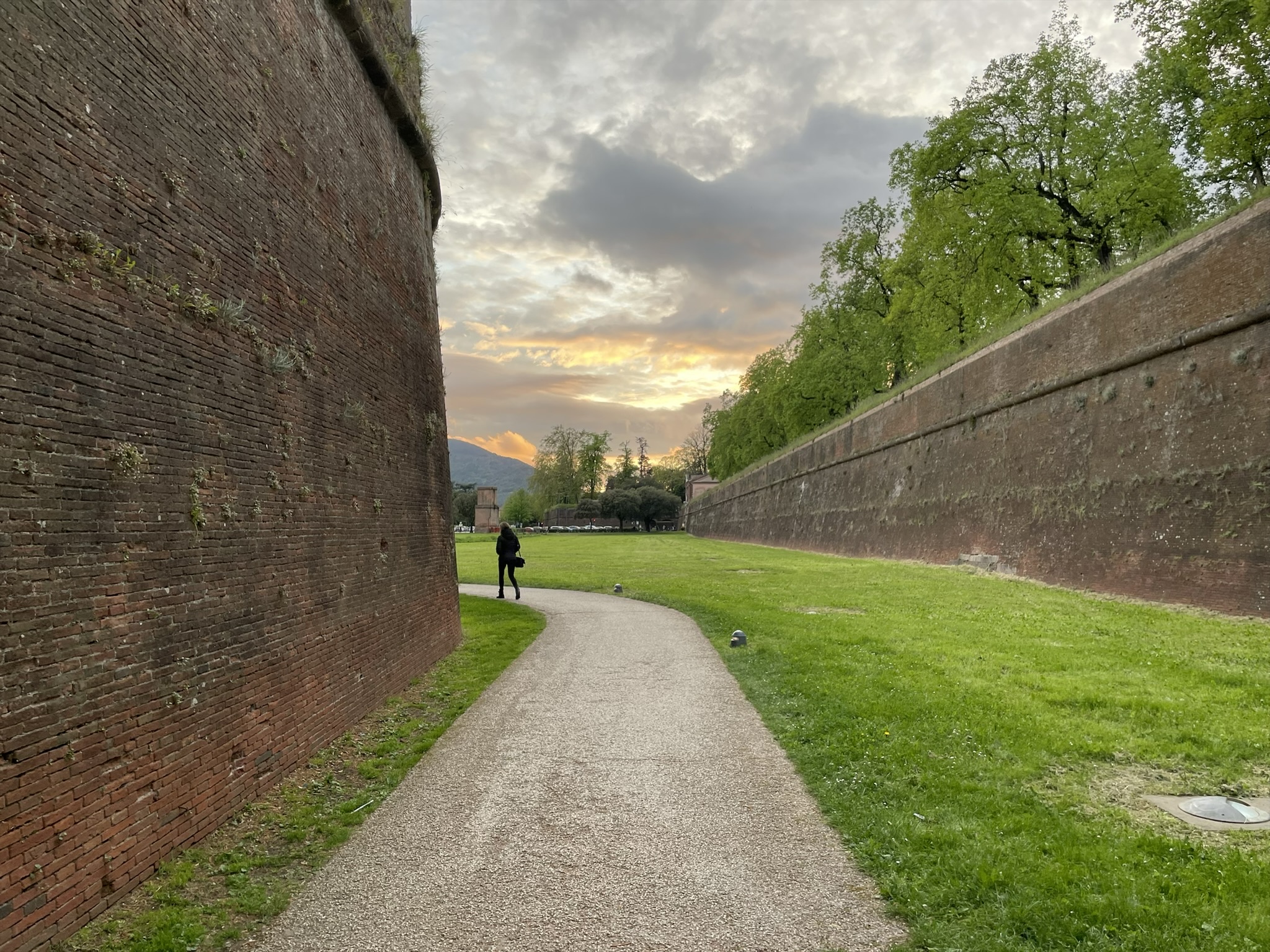
The week just after Easter and before the start of the late spring and summer music festivals turns out to be an ideal time to visit this Tuscan city, about an hour’s train ride from Florence. It’s best known for its ancient fortified walls rebuilt in the 15th-16th centuries, and later turned into 2.6 miles of paved walking and biking paths circling the historic center.

The walls of Lucca

Crowds and and traffic are sparse this time of year, and Covid protections are in force, at least until May 1, including requiring masks in indoor public places and proof of vaccination to enter restaurants and ride long-distance trains. 

Media reports made much of  passengers cheering news that U.S. airlines would no longer require masks. We heard the announcement mid-flight on our way from Seattle to Amsterdam on Delta Airlines. No one cheered (maybe because it was the middle of the night), and most everyone kept their masks on. With cases again rising in the U.S., it feels like a particularly bad idea for people not to mask up. Apparently Air France agrees. We’re flying Delta’s french partner on our way back, and we’re happy masks are still required.

Masking up on the train

I know many still feel unsure about traveling abroad, but it almost feels safer to be in Italy right now than in the U.S. Italians seem to respect the rules around protecting themselves and others, perhaps because they know what it’s like to be hit hard by strict lockdowns, hospitalizations and deaths. They use a digital “green pass” to prove vaccinations and boosters. Everyone here accepts American CDC cards, but it would be nice if we too had a standardized electronic pass.

One convenient change, perhaps brought on by Covid, is there seems to be no need to use cash for even the smallest purchases. We’ve been using Apple Pay everywhere, and although we came with 100 euros leftover from a previous trip, we’ve yet to spend hardly any cash.

Italy has been hit with inflation and soaring fuel costs due to the war in Ukraine, but, perhaps because the dollar is strong against the euro ($1.08), costs are reasonable, and even a bargain compared to prices at home. The bill for our first meal at a local trattoria was $40 for a shared antipasti, two pastas, wine, water and dessert. Local bakeries sell slices of Torta di Erbe,  a Lucca speciality made with spinach or Swiss chard, raisins and pine nuts, for $2 a slice. A cappuccino at our favorite bookstore cafe is $1.50.

Our Airbnb with a very secure door

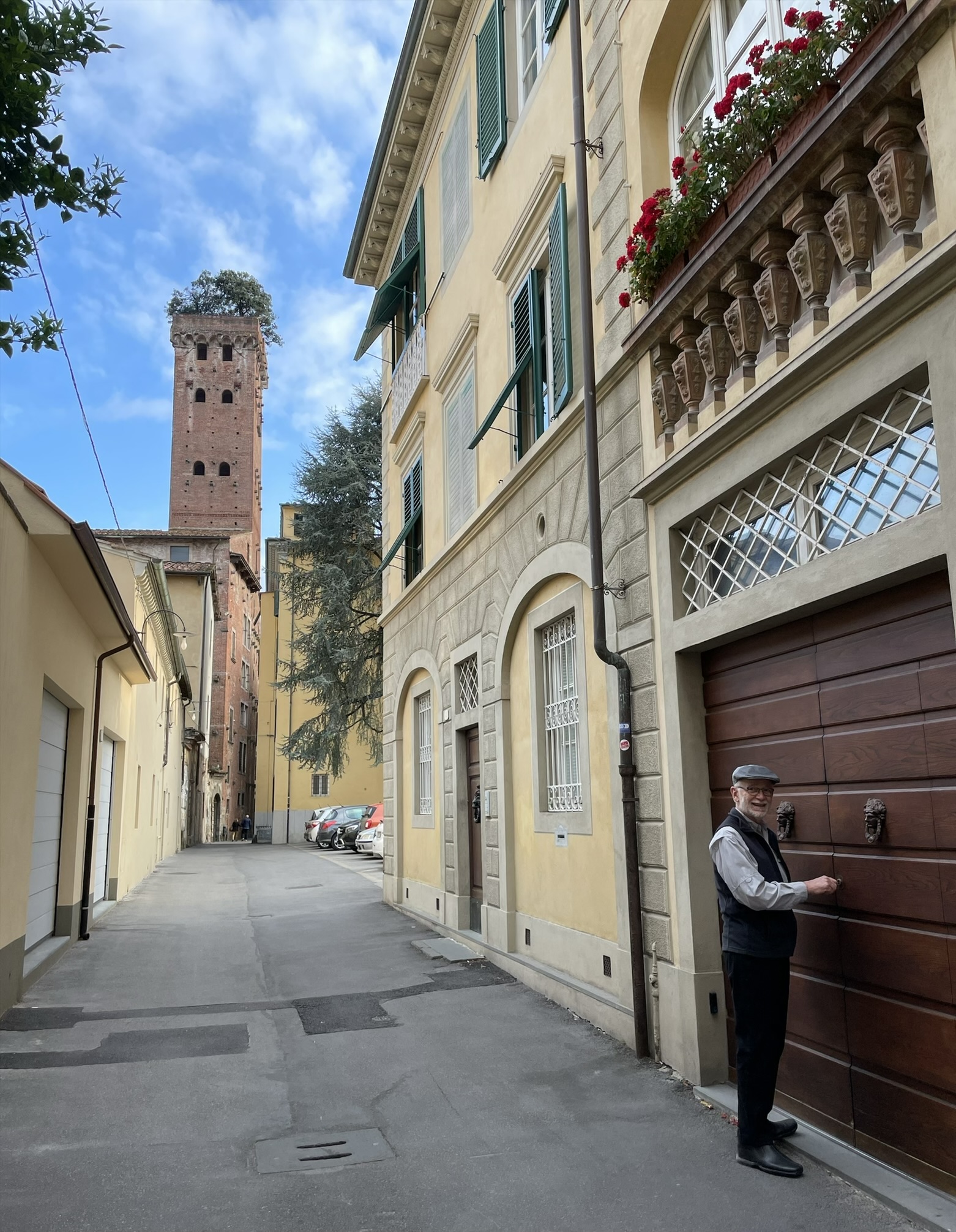
Airbnbs are ideal for Covid-safe travel. Above, Tom unlocks the door to our suite in Lucca’s old town. Our host, Paola, and her family live upstairs. Guests get three rooms downstairs - a bedroom, sitting room and bathroom - with a private entrance. In the distance is a famous landmark, the Guinigi Tower, built by a wealthy family in the 1300s. Powerful families built towers as a symbol of their wealth. The garden on top was designed to get around a height restriction, and assure the owners that their tower would be the tallest. 

Walking the walls

Lucca is like three cities in one. There’s a section originally built by the Romans. Another dates to Medieval times and another to the Renaissance. Wealthy silk merchants financed beautiful piazzas, palaces and parks. Toilet paper has since replaced  silk as the leading export, but tourism revenues ensure everything stays manicured and well-kept.  The composer Giacomo Puccini was born here, and for those who can’t time their visit to a full-length opera, singers perform arias and duets nightly as part of the Puccini en la sua Lucca program. We joined about 50 others in a small chapel for an hour-long concert of selections from Puccini and Verdi compositions. Our seats were so close to the stage that we could make eye contact with the performers, and see the pianist’s musical score.


An intimate opera performance 

Where a Roman amphitheater once stood is the Piazza dell’Anfiteatro, a public square with a ring of buildings built in the same elliptical shape, and reached through four gateways. Cafes

Piazza dell’Anfiteatro

occupy prime real estate for people-watching and listening to summer jazz concerts. Flower-sellers filled the piazza this weekend with flowers and plants to celebrate the feast day of Saint Zita, patron saint of Lucca. Saint Zita, a servant and housekeeper, distributed bread to the poor. When the family for whom she worked caught her smuggling bread from the kitchen, they pulled open her apron, only to find flowers falling to the ground, or so the story goes. To celebrate her feast day, Lucca families bake bread and bring flowers to the Church of San Frediano where her body, believed to be naturally mummified, is displayed.

Flowers at the Church of San Frediano 

Saint Zita with hands and face uncovered for viewing

Heavy rains, thunder storms and strong winds are breaking a four-month drought in Northern Italy just as we get ready to continue our trip along the Ligurian coast to Genoa. Our plan is to  stop for two nights in Chiavari, a seaside town north of the Cinque Terre. If there is a place to hunker down during a rainstorm, this may be it. Most of the shops and restaurants are tucked into narrow streets protected by a network of porticos built by the Genovese in the Middle Ages. We’ll hope for a break in the weather to explore the arcades, parks and seaside, but if all else fails, there’s always this: